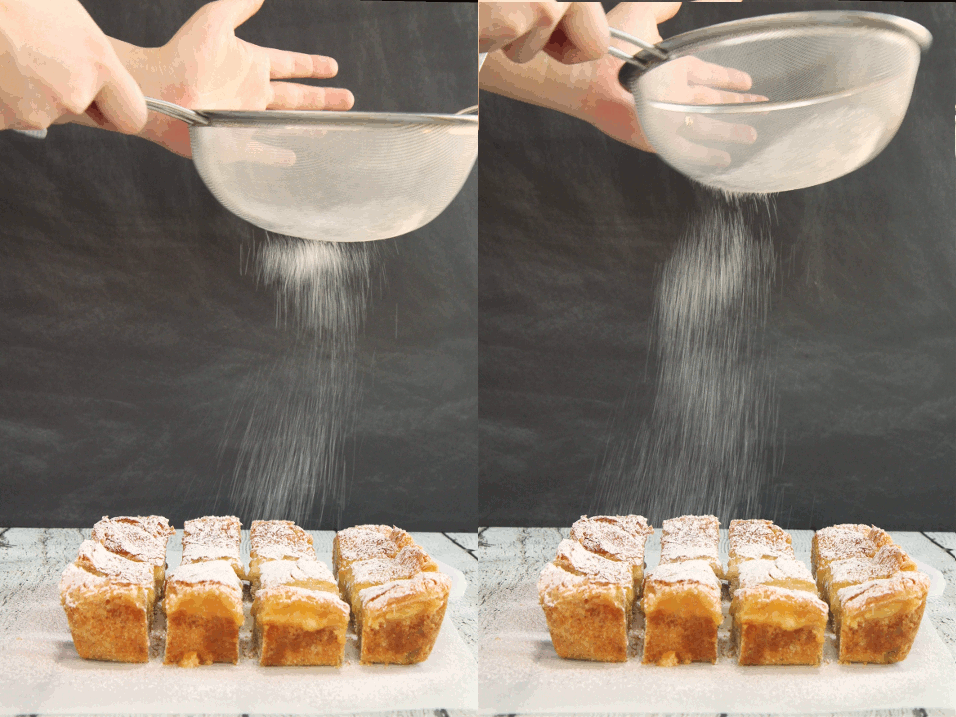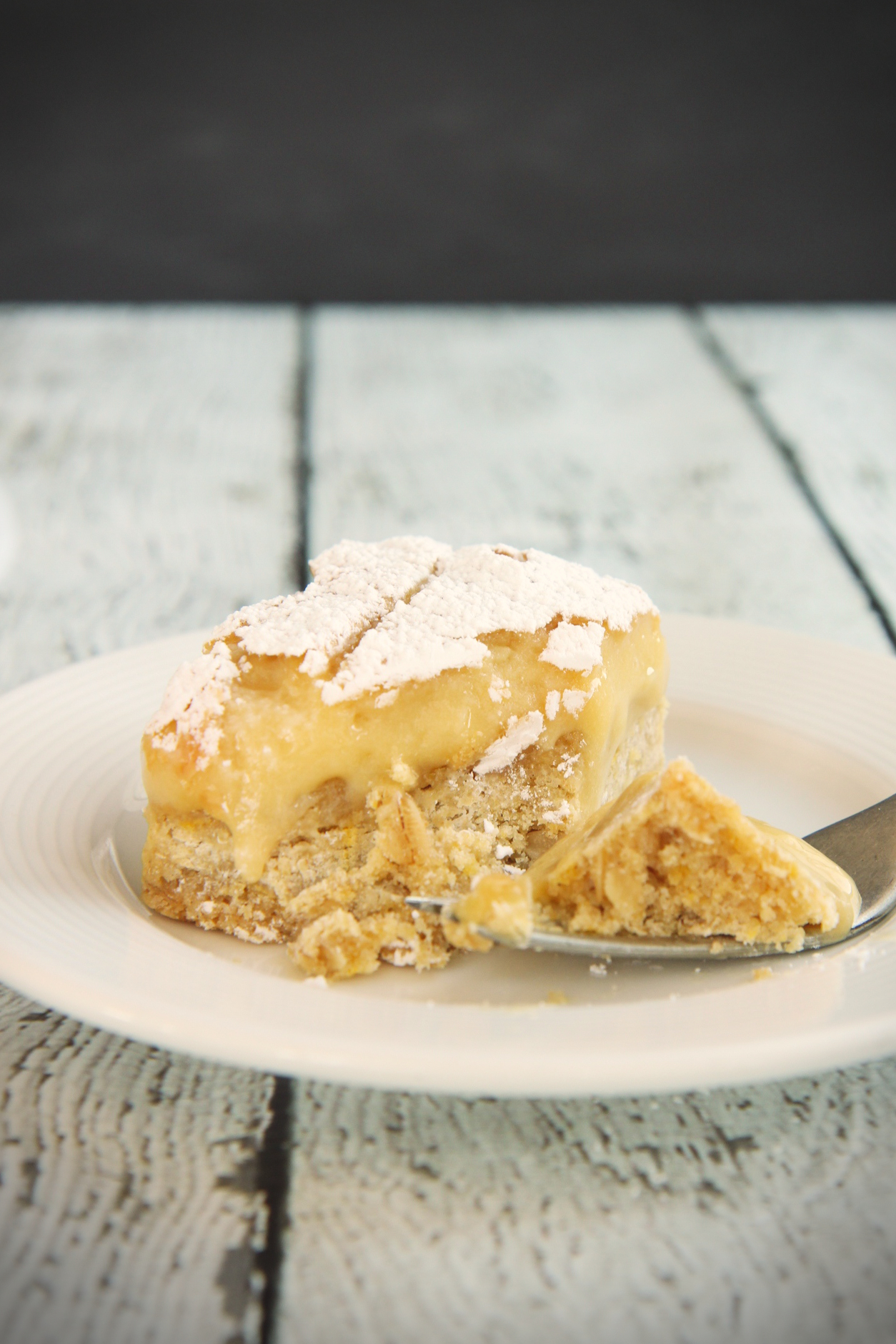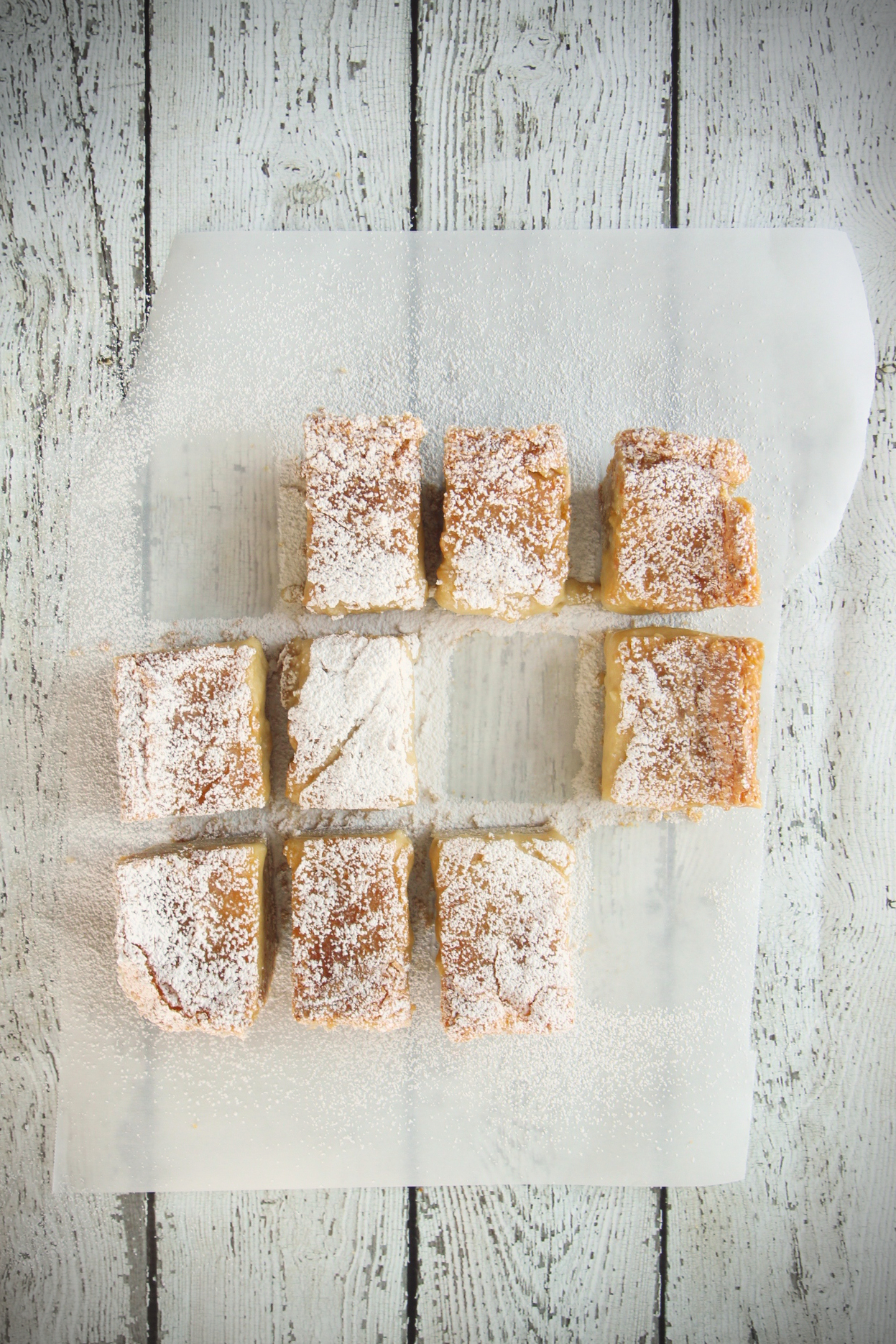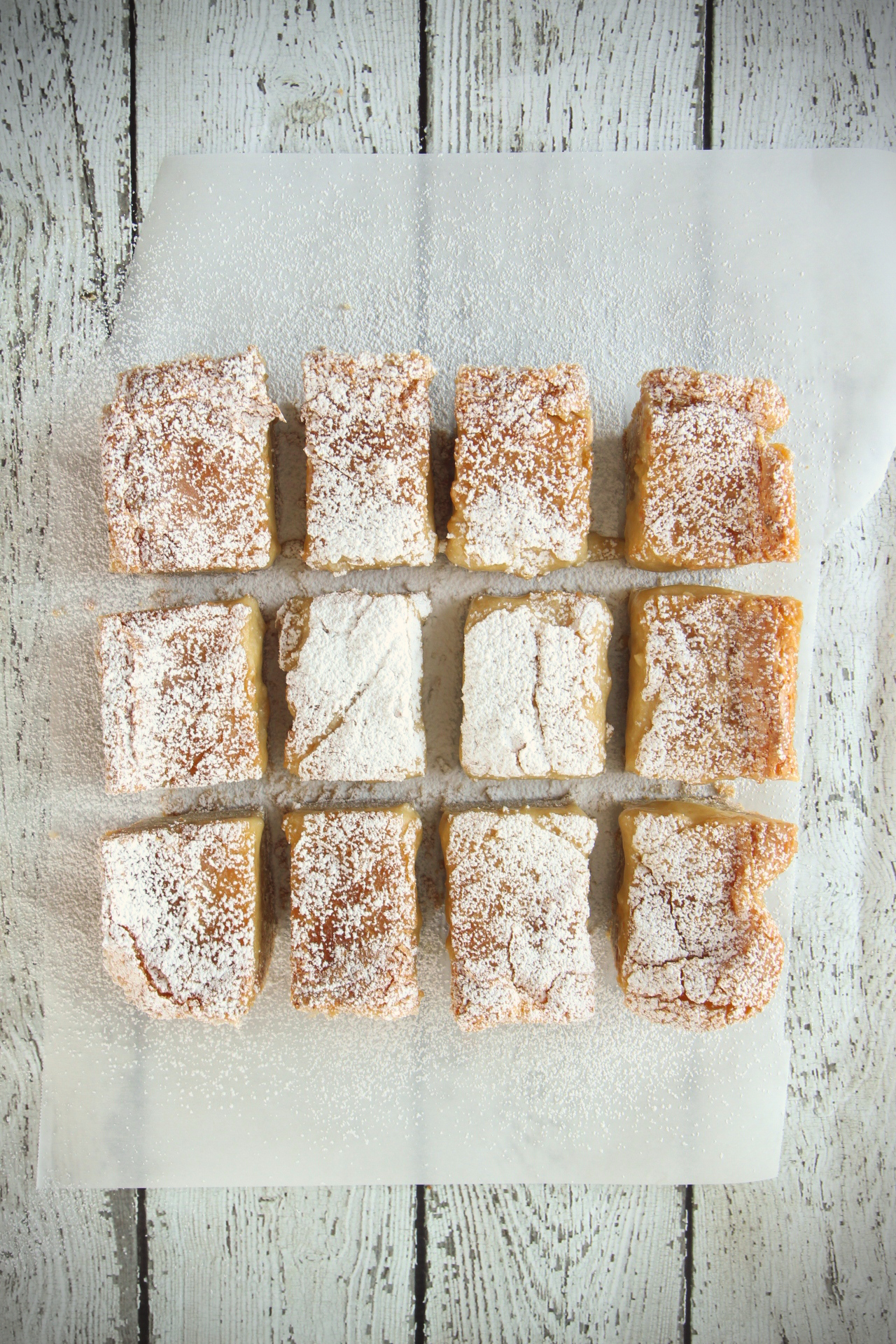
Blink

IMG_9096_01

Yonder see the morning blink:
The sun is up, and up must I,
To wash and dress and eat and drink
And look at things and talk and think
And work, and God knows why.

Oh often have I washed and dressed
And what’s to show for all my pain?
Let me lie abed and rest:
Ten thousand times I’ve done my best
And all’s to do again.

–A.E. Housman

IMG_9118_01

Hi friends!  This is a quick update/reassurance for today.
I’ve got a few great things coming your way, they just need extra time, work, and love, all of which are in short short supply right now.  Things are a little hectic/crazy/busy in my life at the moment, but it will all settle down shortly.
One of these days, I’ll get the chance to sleep for a full 8 hours.  One of these days.

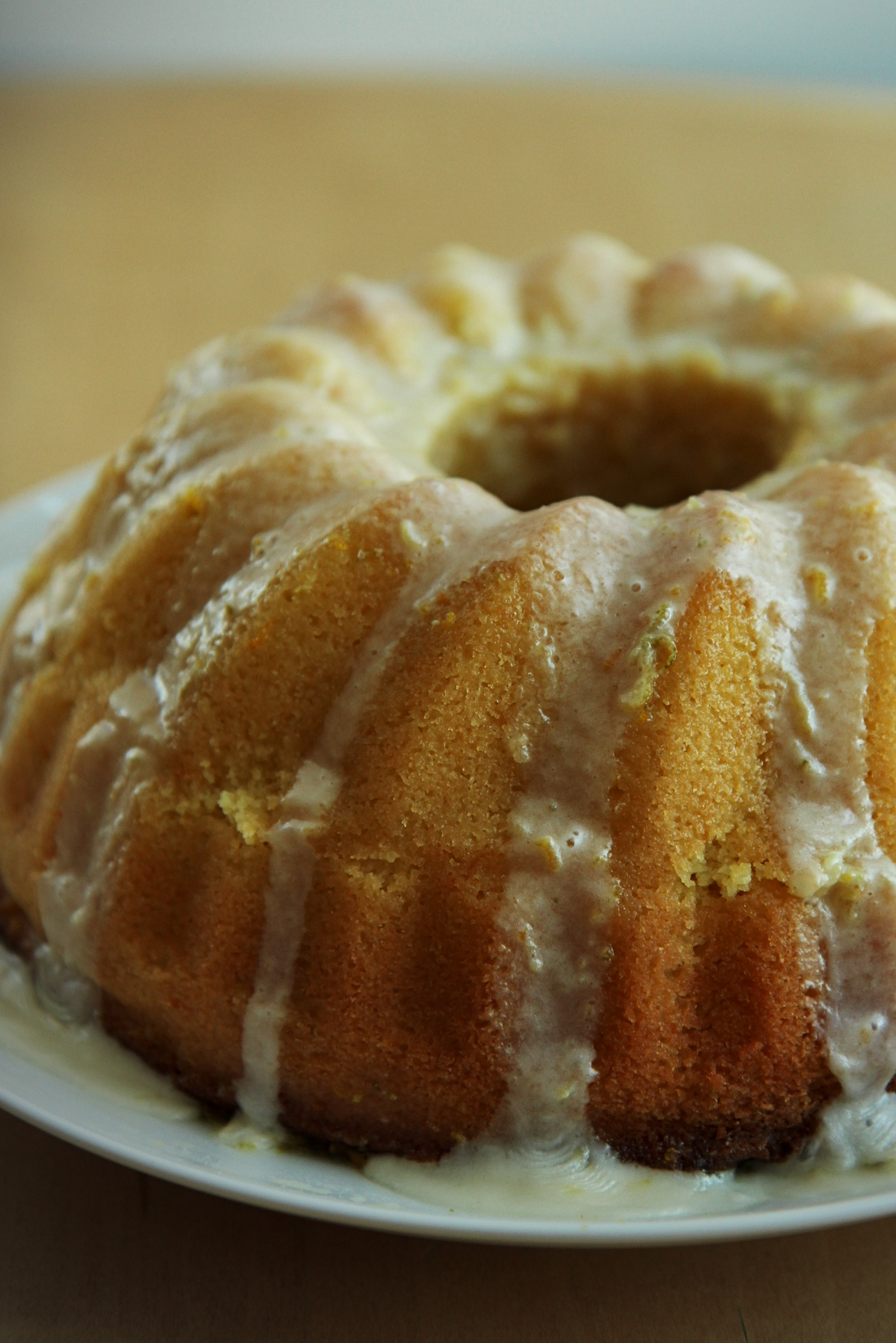
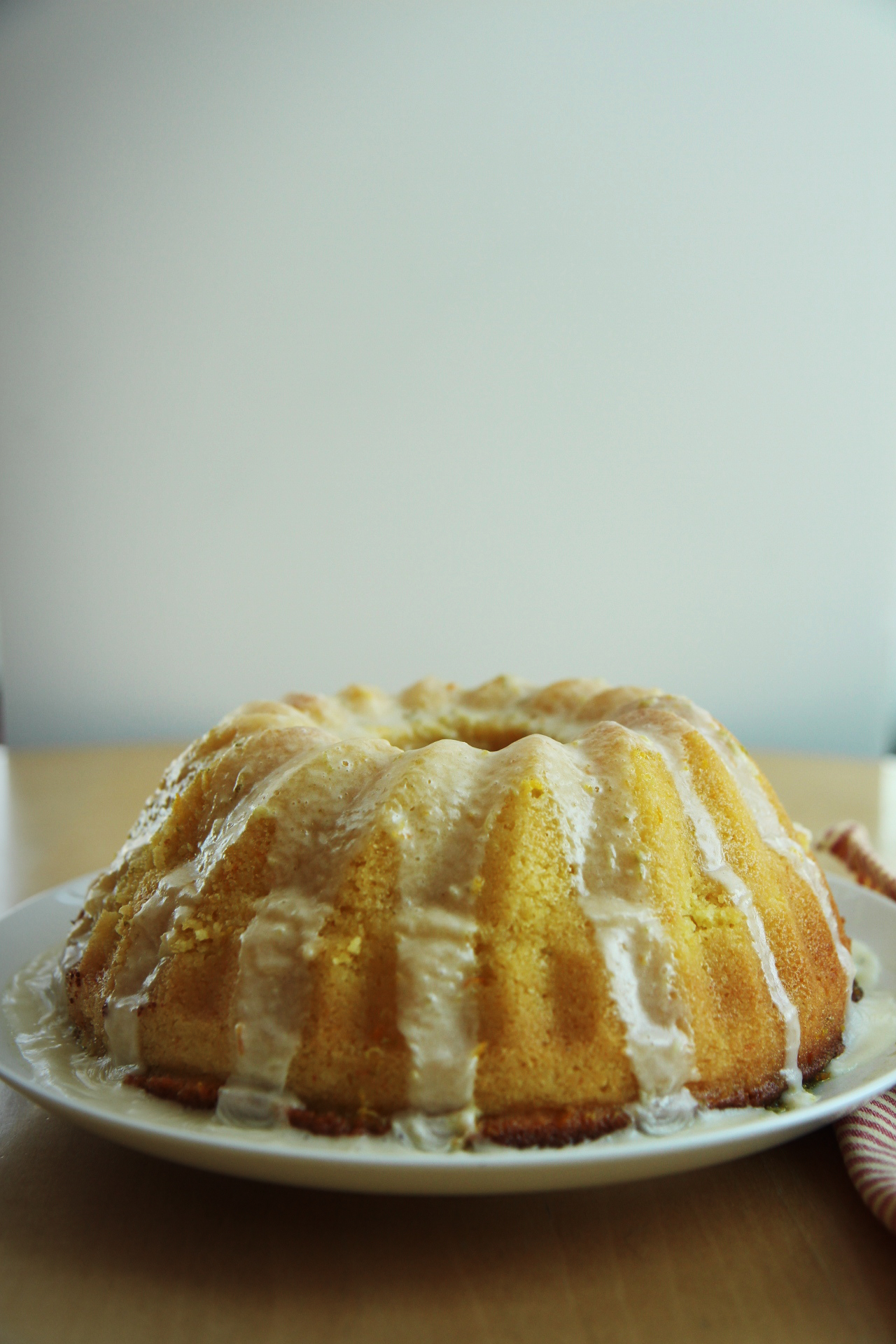
For now, here is the most delicious pound cake I have ever tasted in my entire life.

Buttery, soft, tender pound cake with piles of citrus zest–lime, lemon, and orange– is brushed with a honey lime glaze and topped with a decadent vanilla honey cream icing.

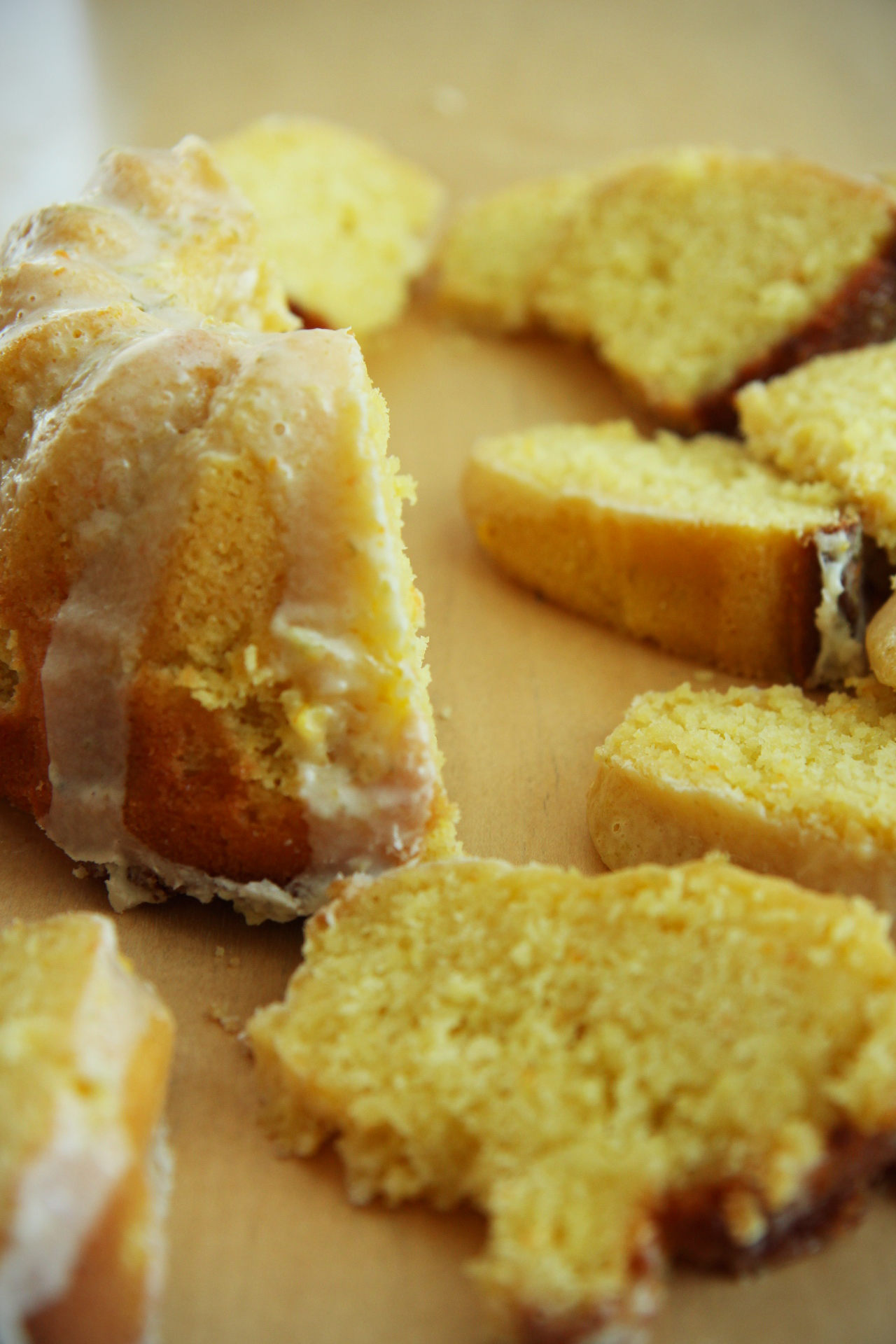
The edges are ever so slightly crispy and crunchy, thanks to the unique shape and surface area of a bundt pan, and all these exterior nooks and crannies are saturated with salty-sweet honey glaze and icing; the interior is moist with delicate citrus flavor and pure buttery texture heaven.

The bright citrus zests add to the gorgeous yellow color– just like the daffodils that have cheerily sprung up around campus!

IMG_9127_01

Twice-Glazed Citrus Honey Pound Cake
cake portion adapted from Bon Appétit

ingredients:
for the cake:
1 cup (16 tablespoons) butter
2 teaspoons kosher salt
2 1/2 cups sugar
zest from 2 lemons
zest from 2 oranges
zest from 1 lime
4 eggs
1 cup milk
1 1/2 teaspoons apple cider vinegar
3 cups flour
1 tablespoon baking powder

for the lime glaze:
zest from 1 lime
juice from 1 lime
juice from 1 lemon
pinch kosher salt
1 tablespoon honey
1-2 cups powdered sugar, as needed

for the vanilla honey cream icing:
2 tablespoons heavy cream
1 tablespoon honey
big pinch kosher salt
1 teaspoon vanilla extract
1-1 1/2 cups powdered sugar, as needed

directions:
Preheat oven to 350 degrees F and grease and flour a 12-cup bundt pan very well.
In the bowl of a stand mixer, place the butter and salt.
Beat for 4 minutes, until softened and very fluffy.
Scrape the bowl and add the sugar and citrus zests, stirring slowly at first, then increasing the speed up to high; beat for 3 more minutes.
Scrape the sides of the bowl and add in the eggs; beat for 3 more minutes.
Stir the milk and apple cider vinegar together; stir the flour and baking powder together in another bowl.
At the same time, going very slowly, add the milk and flour mixtures, alternating if need be but largely adding them simultaneously to the egg mixture with the mixer running.
Once all the flour and milk has been added, scrape the sides of the bowl and beat for a minute longer to ensure homogeneity.
Pour the batter into the bundt pan and bake for 50-60 minutes, until a tester comes out clean.
Meanwhile, make your glazes: whisk the ingredients for each glaze together in separate bowls until no lumps remain.
Add 1 cup of powdered sugar first; if the glazes are still too runny, just add more powdered sugar.
When the cake comes out of the oven, allow it to cool for 10 minutes, then turn it out onto a serving plate.
Cover the cake in as many layers of lime glaze as you can, then allow it to cool for 10 more minutes.
Whisk the vanilla honey icing together to ensure that it is pourable, then spread it over the top of the still-warm cake.
Icing will drip and melt down the sides of the cake.
Allow to cool completely, then slice and serve!

Daisy

IMG_8763_01

A LITTLE madness in the Spring
Is wholesome even for the King,
But God be with the Clown,
Who ponders this tremendous scene–
This whole experiment of green,
As if it were his own!

Emily Dickinson

IMG_8774_01

Mooooo.
Mooooooo.

IMG_8773_01

It is spring.
I can officially, fearlessly declare for spring.
Not just based on the official date (which was March 20th, but since it was still snowing in March, that didn’t seem quite right), but on the birds chirping and the sun shining and the people smiling.
The bare skin, the promising buds, the gentle scent of life on the breeze.

The smell, the feel, the sight of spring.
I feel invigorated.  Alive, awake, alert, enthusiastic.

IMG_8766_01

Babies abound in spring; I imagine calving is happening (although I’m trying not to imagine the horrors of calving on a factory farm, since I wanted this post to be upbeat and happy…), little wobbly kneed newborns frolicking in the sun.
If I had a farm or a country home with a cow, I’d name her Daisy.  Real original, right?
She’d be a little Jersey cow, and I’d have 2 goats and some chickens, too.

There is something very romantic about the thought of living and working on a rustic farm; it’s kind of a secret dream of mine to grow up and be Imen of Farmette.
Or maybe not so secret.

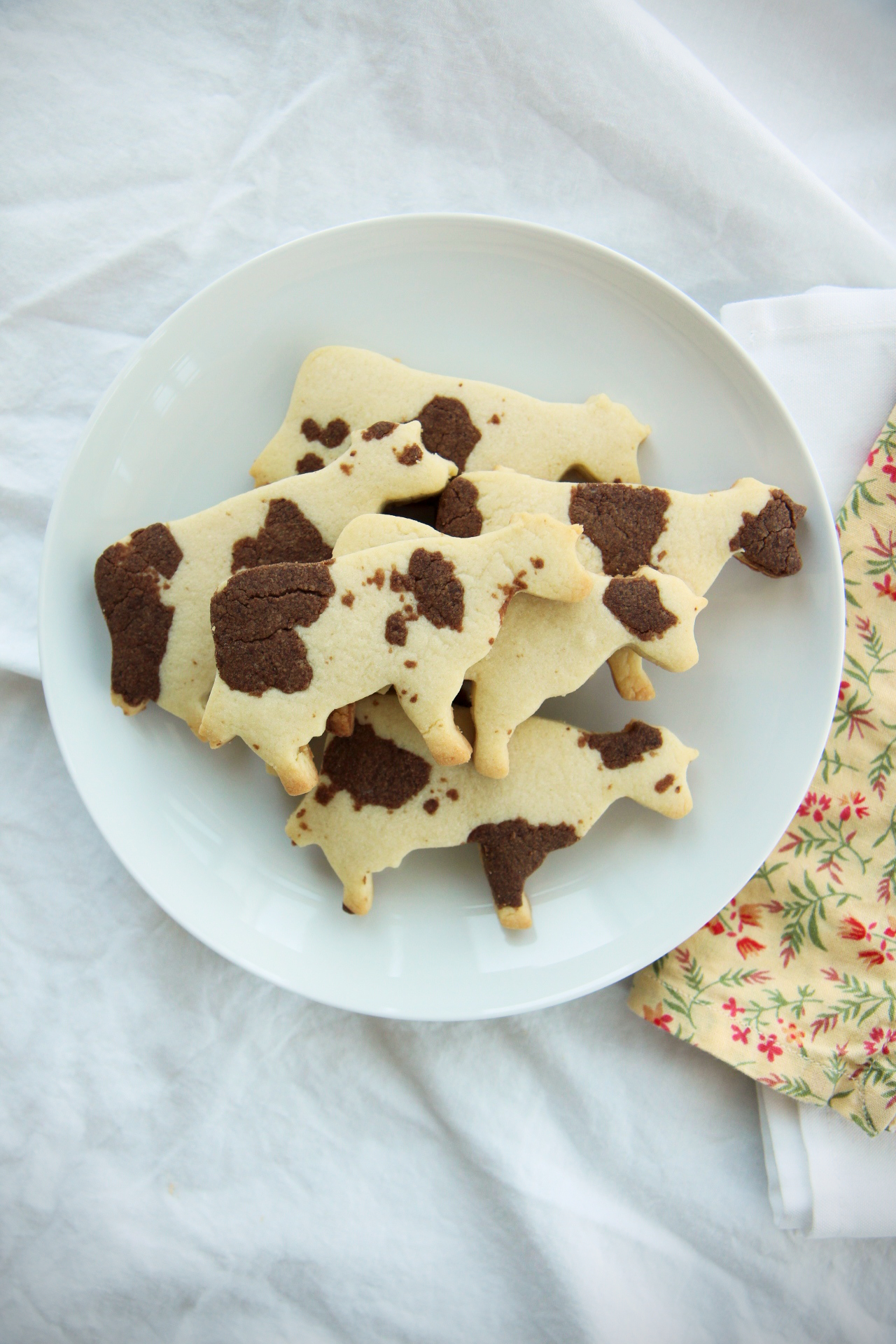
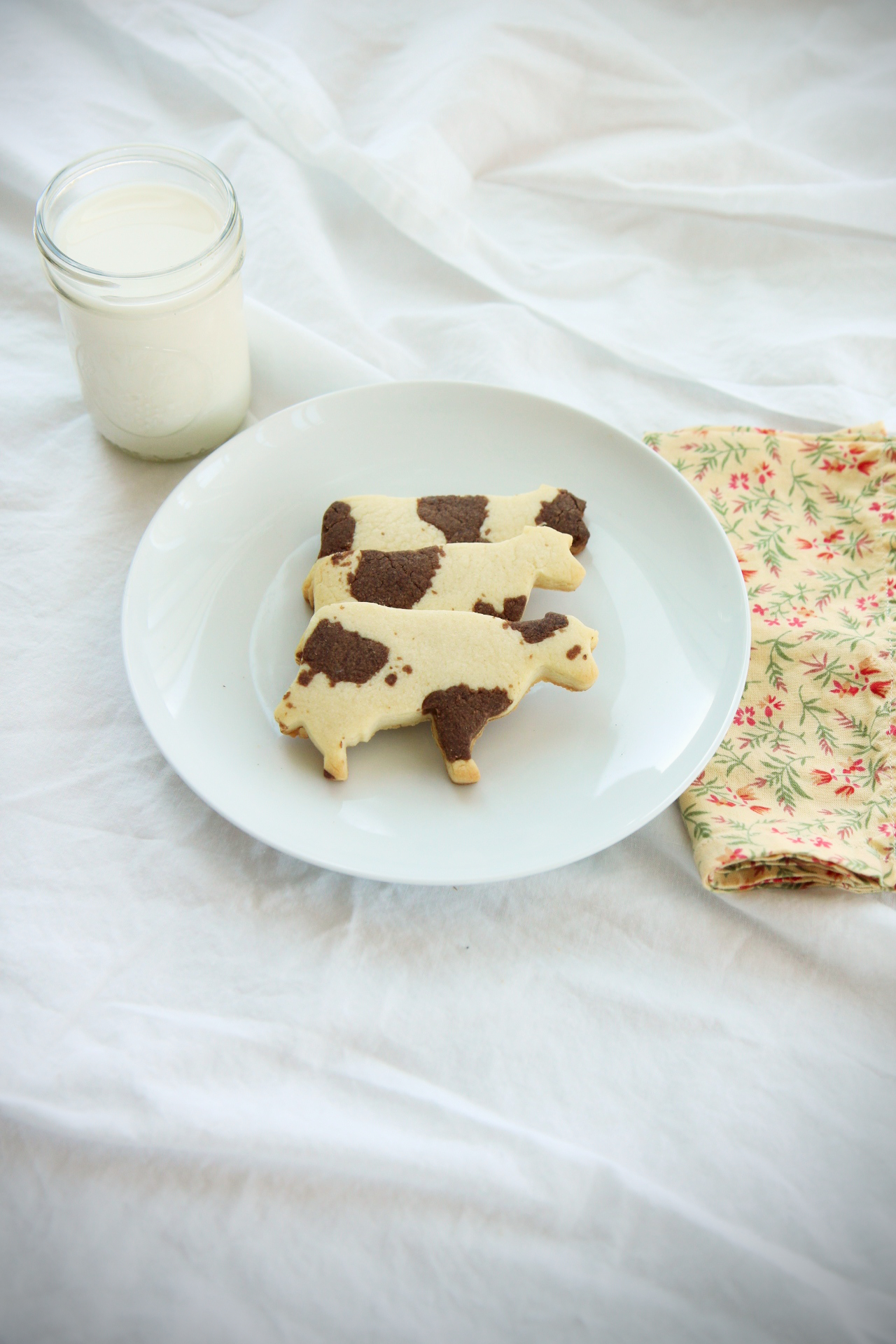
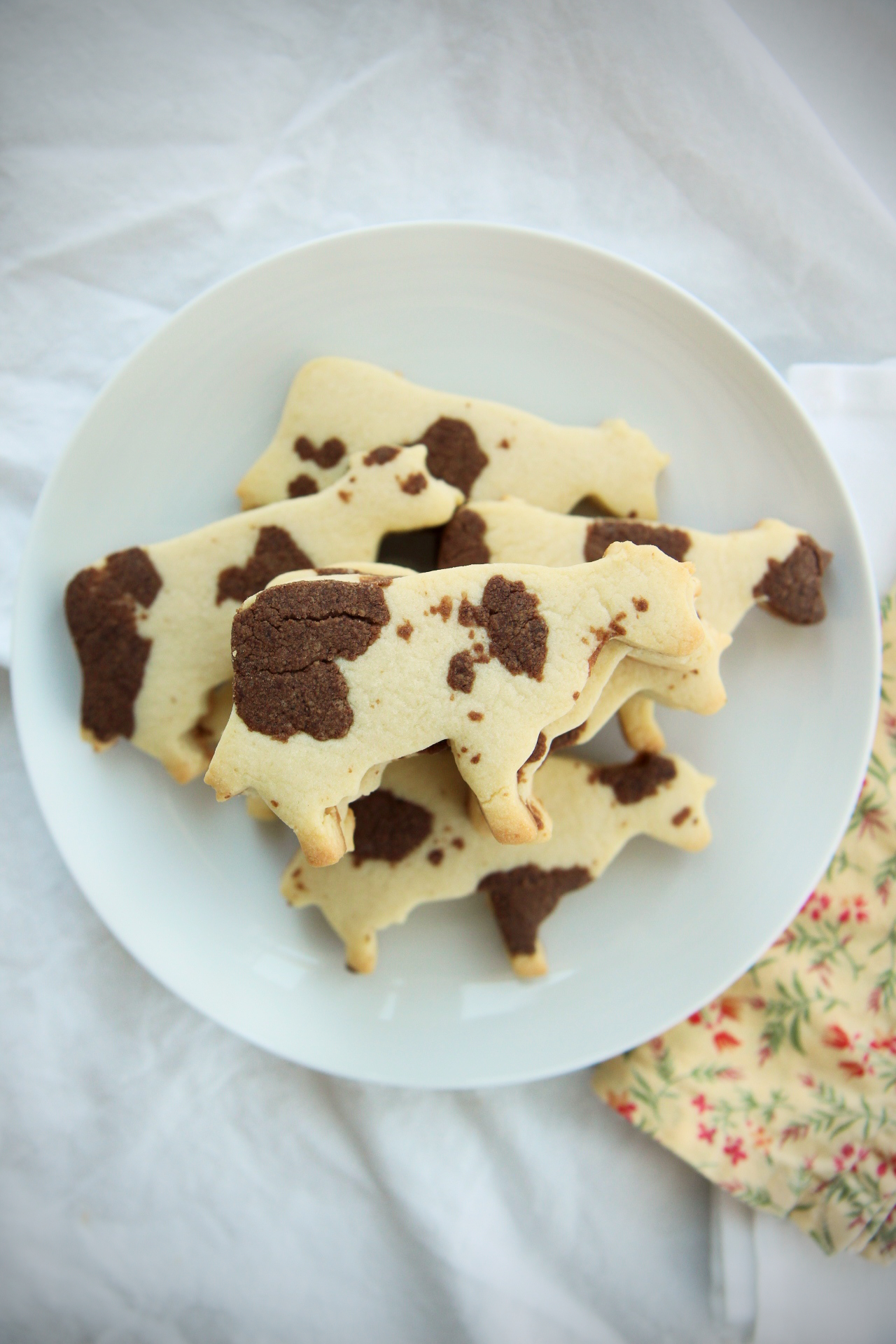
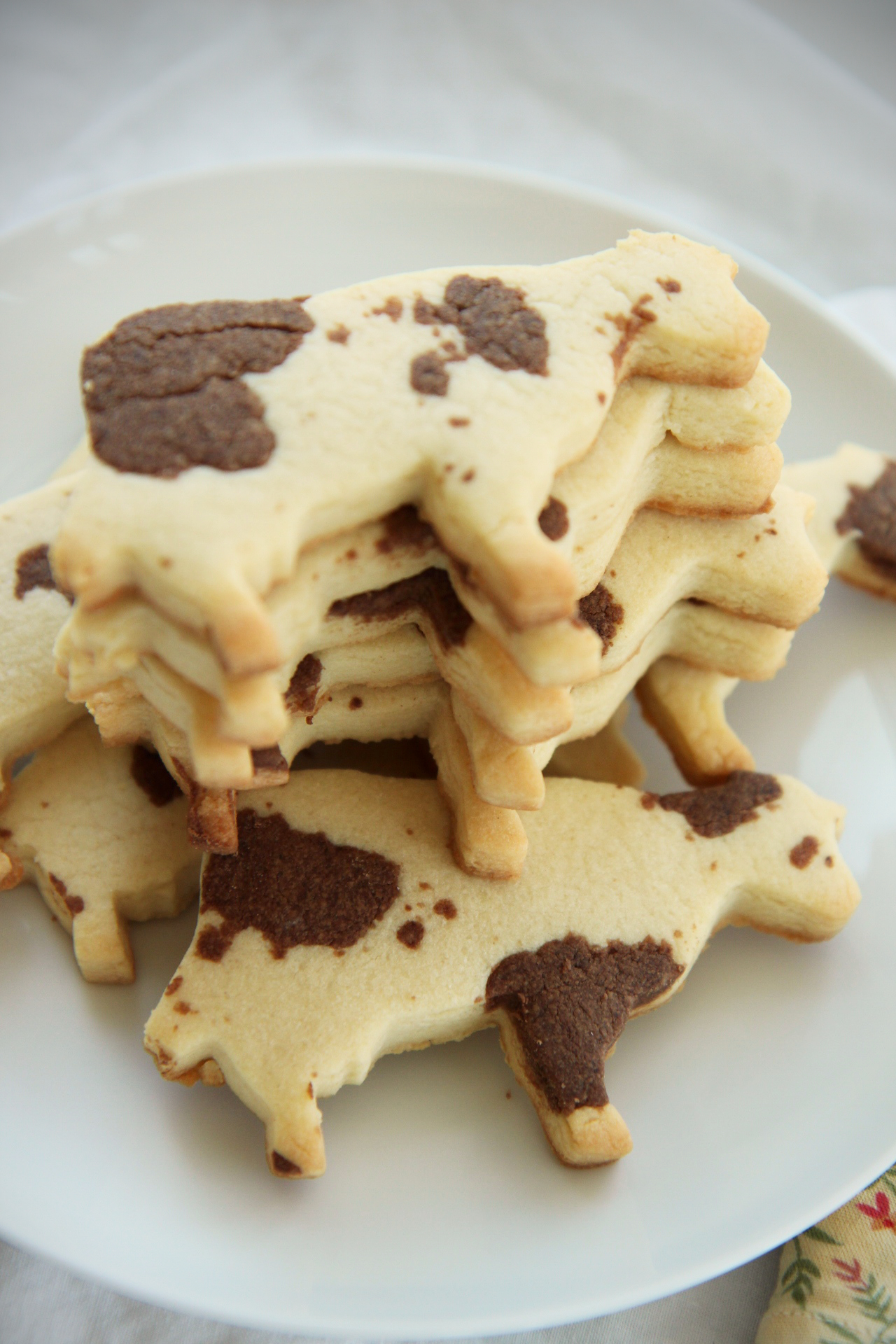
These here cows are Holsteins, though.  Or at least my best approximation of them.

IMG_8767_01

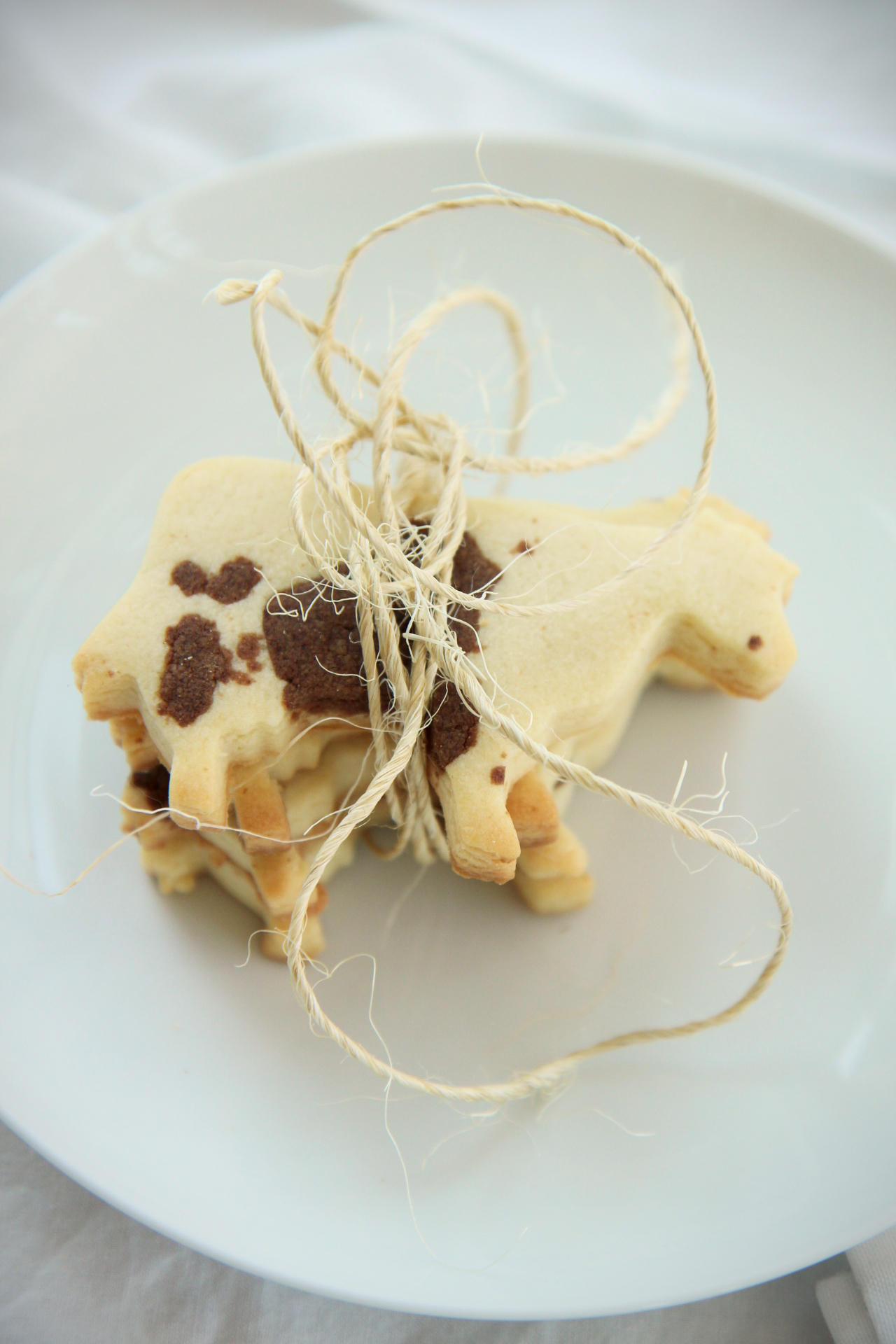
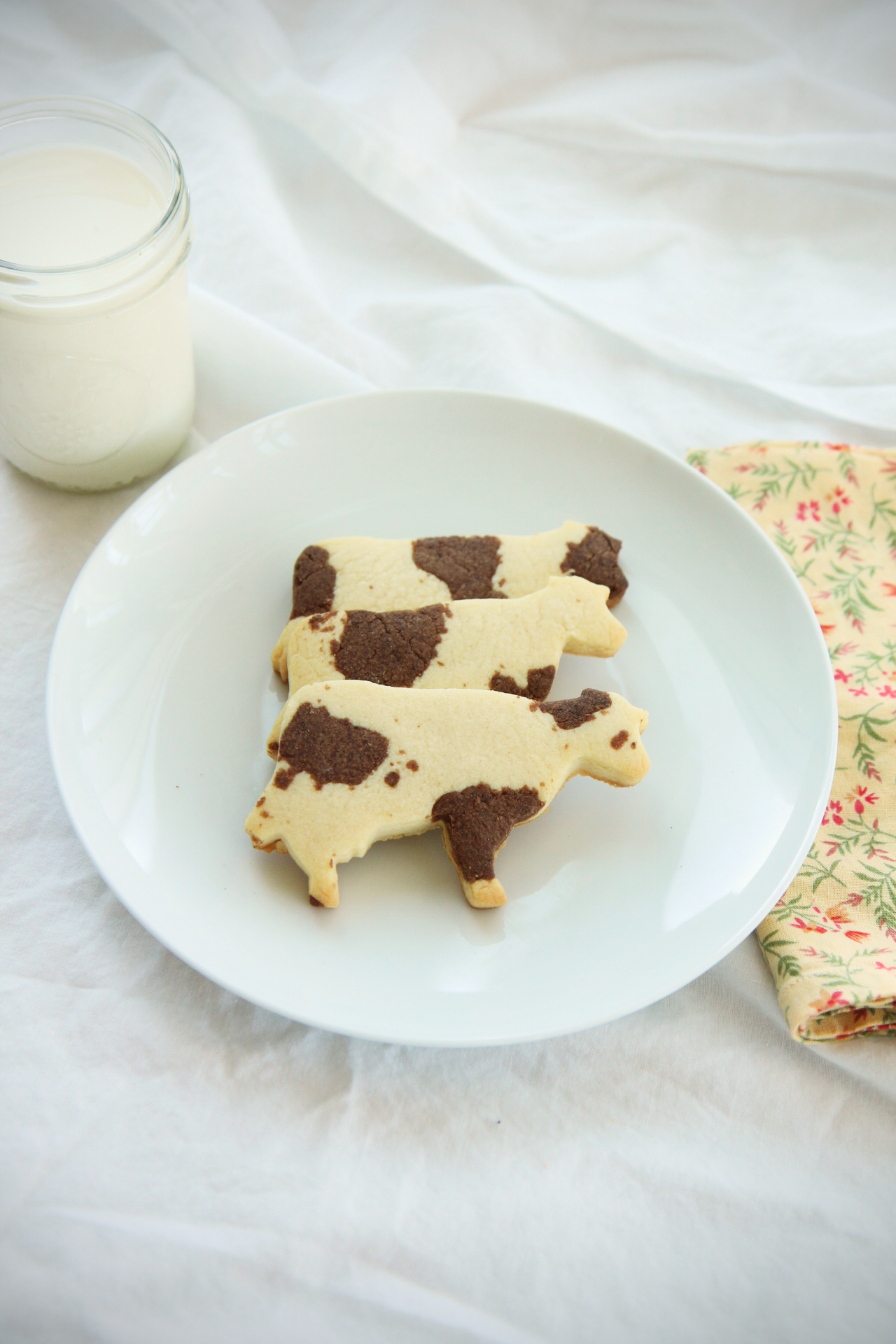
These cow cookies are so sweet!
When I saw this cookie cutter, I had to have it.
Now I’m dreaming of more spotted animals that I could create using the same technique.
Giraffes are my house mascot, after all…

These cows are crisp butter cookies laced with salt and vanilla, punctuated with rich, chocolatey bites.

Simple, simple cookie dough (count down from 3, then back up: 3-2-1-1-2-3) means that you can have these cookies in just about an hour, including chilling time.

There is nothing like a thick, crunchy-on-the edges sugar cookie with a soft center dipped in milk.

You absolutely must enjoy these with milk.  (Is that wrong?)

IMG_8776_01

Cow Cookies
makes about 20 large cookies

ingredients:
3 cups (360 grams) flour
2 sticks (225 grams) butter
1 cup (200 grams) sugar
1 egg
2 scant teaspoons kosher salt
3 teaspoons vanilla extract
1 ounce bittersweet chocolate, melted and cooled
1 teaspoon (5 grams) cocoa powder

directions:
Place butter in the bowl of a stand mixer fitted with the paddle attachment and beat on high for 2 minutes.
Add the sugar and beat for 3 more minutes.
Scrape the sides of the bowl and add the egg and salt; beat for 3 more minutes.
Add the vanilla extract and the flour and slowly mix until homogeneous.
Remove 5/6 of the batter, leaving the last 1/6 in the bowl; add the chocolate and the cocoa powder and beat until batter is uniformly colored.
On a well floured surface, roll out the vanilla dough to a thickness of 1/4 inch.
Rip random and varying sized pieces of the chocolate dough off and flatten them slightly.
Place randomly on vanilla dough and gently roll to incorporate.
Cut out cow shapes with a cutter, doing your best to fit as many cookies in as possible to avoid having to reroll the dough.
Place on a cookie sheet lined with parchment and into the freezer.
You can reroll the dough, but the cow spots will not be distinctive.
Freeze for at least 30 minutes.
Preheat oven to 350 degrees F, then bake cookies for 10-12 minutes, until lightly golden.
Allow to cool; enjoy with milk.

All Hail

IMG_8704_02

My good lords and ladies, would you care for a bloody poofy woolly biscuit?

IMG_8727_02

What, that doesn’t sound appealing to you?!
Allegedly, that’s what Lord Lamington, after whom these little confections may or may not be named, was fond of calling them, and not exactly lovingly.

The history of the lamington is a bit convoluted, with different stories attributing its origin to various sources.
They’re quite widely popular, so there must be something behind them.

Lamingtons are enjoyed from Queensland to Toowoomba to South Africa to… Cleveland.

(In other Australia-related news… more weird ass marsupials discovered on the only freaky continent to boast marsupials!)

IMG_8722_02

When I found some desiccated coconut in the famed and fabled land of Hyde Park Produce, I knew instantly I had to make lamingtons. (After, of course, I stirred heaps of it into this cake and this cake, too.)

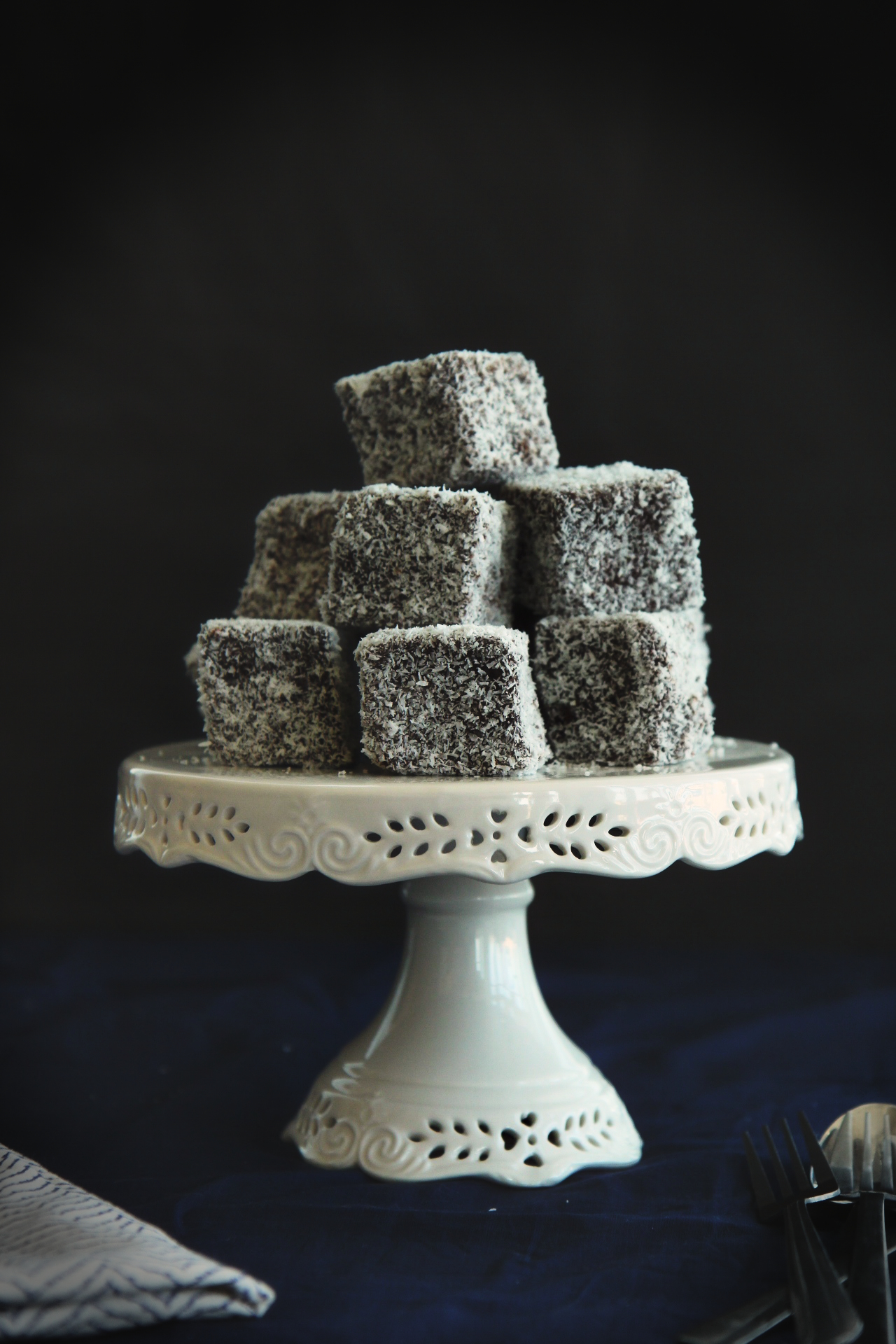
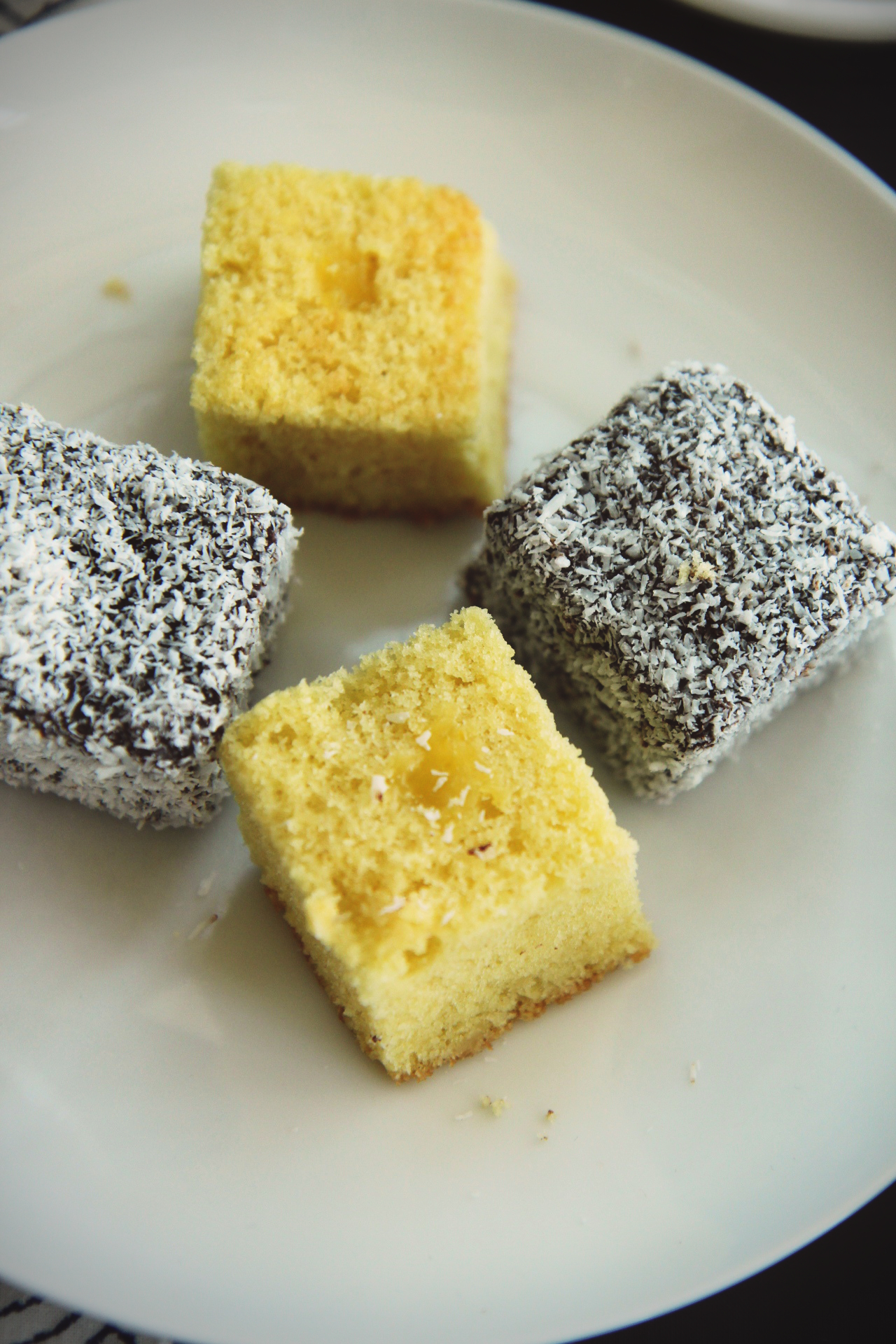
The traditional form is a cube of vanilla sponge cake, sometimes split in two and filled with jam, dipped in chocolate glaze and covered with coconut.
I didn’t deviate too much, because I’ve never tried a real lamington!

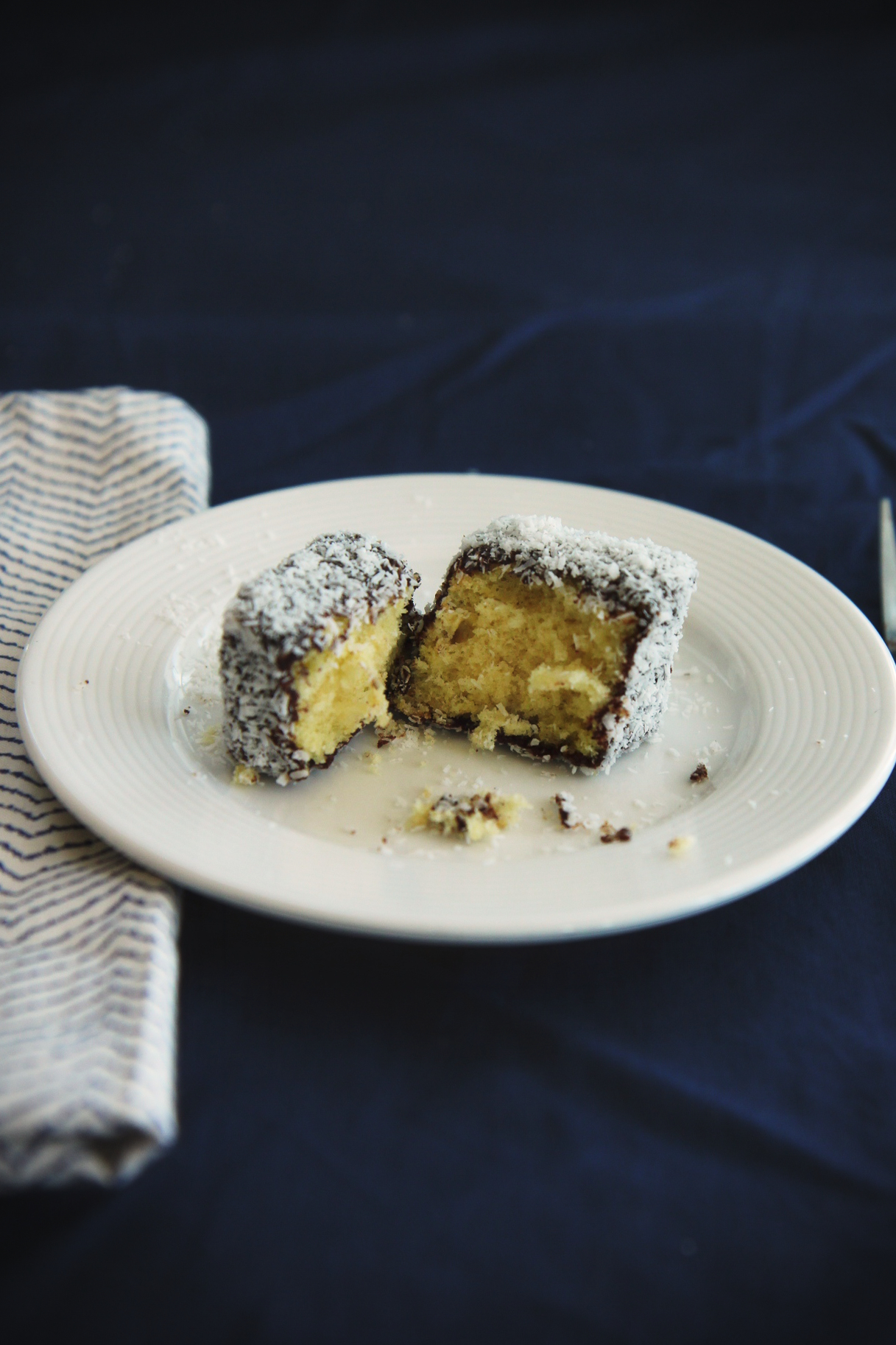
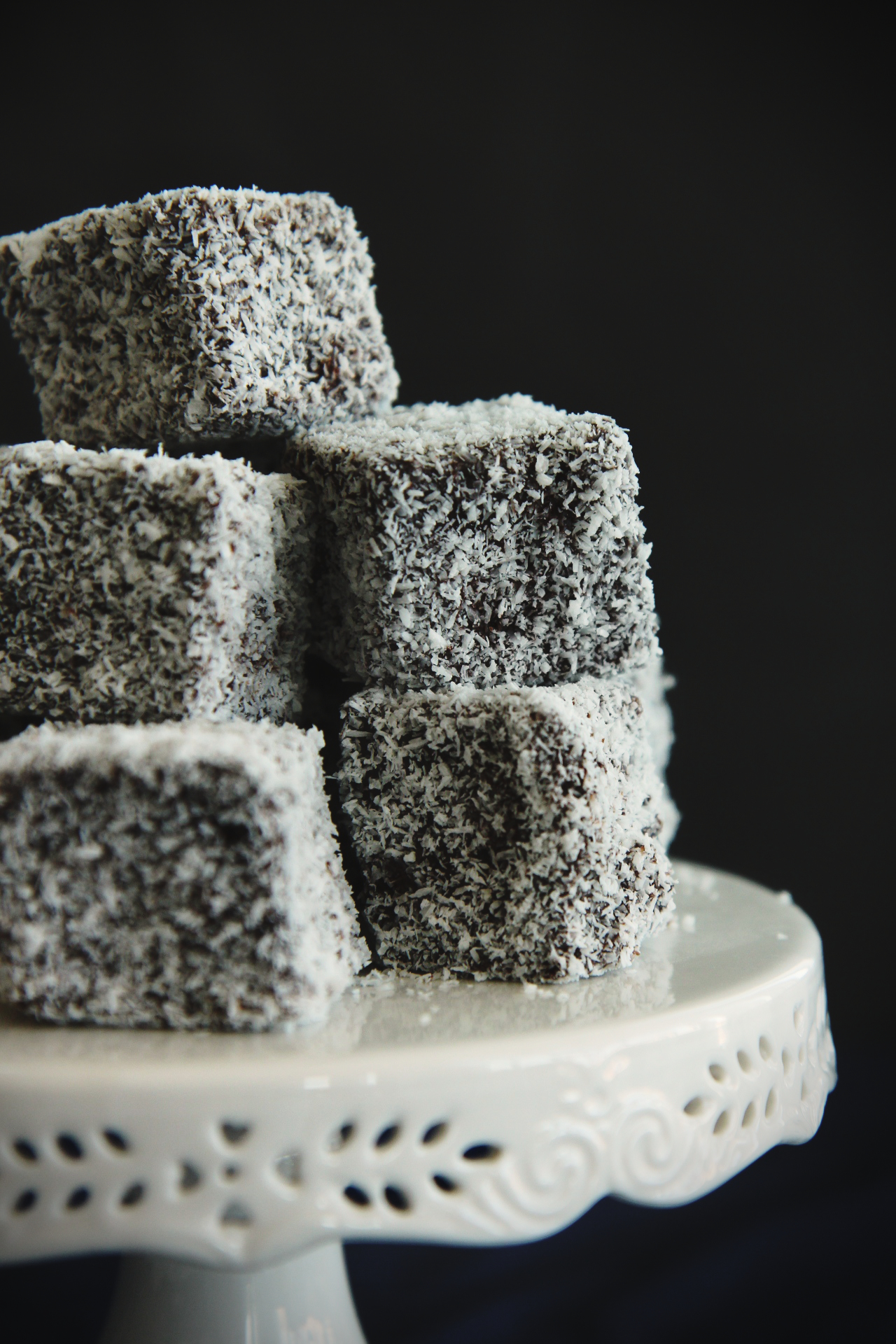
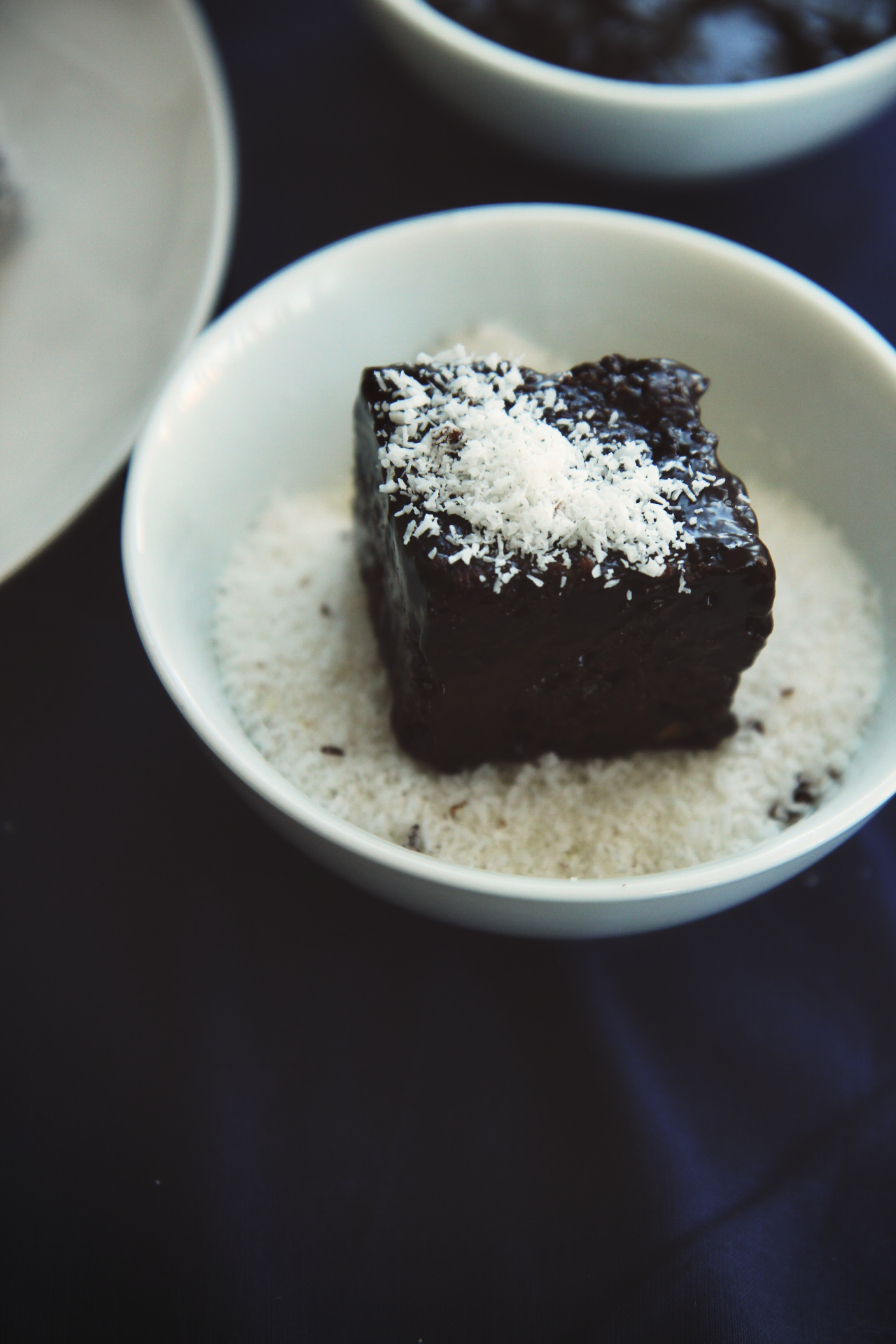
Here, a moist, light vanilla sponge cake is filled with rich, thick coconut pastry cream, coated in a dark bittersweet chocolate glaze and dusted with plenty of chewy, nutty desiccated coconut.

Lord Lamington must have been crazy, because these treats are fabulous.
They’re really not sweet, with a myriad of textures: the sponge cake is fluffy, the coconut cream buttery, the glaze melty and the coconut shreds are chewy.
The flavors meld beautifully, with the coconut pastry cream giving an aroma of coconut to the interior as well as the exterior, the thin shell of chocolate not overpowering the delicate vanilla or coconut.

These were snapped up from my house table ridiculously quickly; people remarked how pretty and how delicious they were.
(Nary a “bloody poofy wolly biscuit” to be heard!)

IMG_8753_02

A few notes about making these poofy little delights:

Trim the edges off your sponge cake! This keeps it moist and allows you to level any imperfections off.
Don’t worry too much if your cubes are kind of wonky, mine were like that too.  They taste just as good.

If your pastry cream is a bit thick, just stir it around vigorously, or fold in stiffly whipped cream.
The pastry cream recipe unavoidably makes more than you’ll need, but you can use it to sandwich more cakes, or thin it with a bit of milk or cream for coconut pudding!
To pipe it into the cake, don’t be shy.  Stick the tip of your pastry bag into the center of the cake and apply pressure.
As the crevices in the sponge cake fill up, the tip will be shoved out of the cake, and you’ll know that it’s full!

When covering the cakes with the glaze, less is more.  Scrape off as much as you can, leaving only a thin lacquer of chocolate.  Otherwise a lot of it will drip into your coconut, and the cakes won’t be as neat.

Desiccated coconut may be a little difficult for some to locate; look for it in ethnic sections or ethnic supermarkets (mine was an Arabic brand).
If you can’t find it, it seems that flaked or even shredded coconut does the job well enough.
Don’t let the coconut hold you back from trying lamingtons!

As always, serve with a good strong cup of milky English tea.
(Yes, Australians have teatime too, thank you O Great British Empire.)

P.S. I’m back in the States.  Woohoo. So glad…  I can feel my tan fading already.  Great.

IMG_8760_02

Coconut Cream Lamingtons
makes 16
cake portion adapted from Saveur
pastry cream adapted from the Kitchn

ingredients:
for the sponge cake:
3 eggs
1/2 cup sugar
1/2 teaspoon kosher salt
1 teaspoon vanilla
8 tablespoons butter, melted
1 cup flour
1 teaspoon baking powder

for the pastry cream:
3/4 cup full fat coconut milk, well stirred
1/4 cup sugar
2 tablespoons flour
big pinch kosher salt
2 egg yolks

for the ganache:
6 ounces bittersweet chocolate, chopped (approximately 1 cup)
scant cup powdered sugar
1/4 cup cocoa powder
3 tablespoons milk (feel free to use coconut milk)
pinch salt
1 1/2 tablespoons butter

to assemble:
1- 2 cups desiccated coconut

directions:
Make the cake: grease and flour an 8×8 pan.
Preheat oven to 350 degrees F.
Place eggs in the bowl of a stand mixer fitted with the whip attachment.
Whip on high for 3 full minutes– set a timer.
With the mixer running, add the salt and slowly stream in the sugar.
Beat for another full 3 minutes– set a timer.
Whisk the vanilla extract into the melted butter, then pour it into the whipped eggs.
Dump the flour (gently) on top, then add the baking powder to the flour mound.
Gently, using folding motions, incorporate the butter and flour into the eggs.
The batter should be homogeneous– you will have to mix thoroughly yet gently– but not completely deflated.
Spread the batter into the pan.
Bake for 25-30 minutes, until a tester comes out clean and the cake is golden.
Allow to cool completely, then slice off the edges and top so that it’s all level.
Meanwhile, make the pastry cream: blend all ingredients except vanilla together, either with an immersion blender or in the canister of a regular blender.
Pour into a small saucepot and cook over medium heat, whisking constantly, until thickened to a pudding-like consistency.
Remove from heat, blend again if there are chunks, and allow to cool before filling lamingtons.
Make the ganache: melt the chocolate, gently, in a double boiler or in the microwave.
Add in the powdered sugar, cocoa powder, milk, salt, and butter, and blend with an immersion blender (or, again, in a regular blender or food processor) until shiny and smooth.
Ganache should be thin enough that it will not pull many crumbs off the cake, so add another tablespoon or two of milk if need be.
To assemble lamingtons, slice cake into 16 cubes.
Fill a pastry bag fitted with a plain tip with the coconut pastry cream; stick the tip into the center of a cube of cake and fill until the pressure forces the tip out of the cake.
Dip the cakes into the ganache, being sure that the chocolate coat is very thin, not thick and heavy.
Brush any excess ganache off, then roll the wet cube in coconut.
Set on a parchment-lined baking sheet to set for at least 2 hours.

It Gets Better

IMG_8454_01

“When I was a girl, my life was music that was always getting louder. Everything moved me.
A dog following a stranger. That made me feel so much. A calendar that showed the wrong month.
I could have cried over it. I did.
Where the smoke from a chimney ended. How an overturned bottle rested at the edge of a table.
I spent my life learning to feel less. Every day I felt less. Is that growing old? Or is it something worse?
You cannot protect yourself from sadness without protecting yourself from happiness.”

— Jonathan Safran Foer | Everything is Illuminated

IMG_8439_01

Eleven weeks has this year been.

Magically have the hours stretched into days, weeks, months.
In the moment, the minutes melted like molasses, yet here we are, looking back at the accumulation of time piled high like snow drifts.
The quarter gusted by, ruffling my hair, picking at the edges of my jacket, freezing my salty tears to icicles.

Time, that infallible, indefatigable soldier, marches on.
I pool myself at his knees, pull at his clothes, cry, implore him for more, more, more.
I beg a retreat, a repeat– just one– beg for second chances, for one minute, one hour longer.

But he is deaf, this cruel god.  There is no rewinding, no turning back.
Done is done; done is done, calls his war drum.
Onward we march.  Forward we go.

IMG_8496_01

Eleven weeks has this year been.

One, two, three months.  Two thousand fourteen.  Twenty fourteen.

The year began as a frenzy of tears, of dually joyous and grieving reunions, of family and love and support and then fell into a deep well of loneliness and numbness, of steely walls and wintry blues, of homesickness and exhaustion.
Slowly, though, 2014 stabilized to an equilibrium.
Just as there was sadness, there was celebration.
Just as there was remembrance, there was readjustment and renewal (even some resolutions).

Healing is not easy.
But you cannot protect yourself from sadness without protecting yourself from happiness.
One walks hand in hand with the other.
And so must we, as their waves beat down on our beaches, as they soften and change our malleable souls.
This submission is not comfortable; it is not easy.

We do not like to be changed.

IMG_8491_01

Yet what can I say?  It gets better.

Things get better.  I don’t eat dinner alone in the stairwell anymore, cold and alone.  I let warmth into my life.
I don’t cry when I’m falling asleep; I don’t cry when I wake up.  I smile, and stretch, long and satisfying.
I don’t feel like my lungs are collapsing in on themselves when I think about you.  I breathe deeper, and deeper still.
I don’t feel my heart break anew into a million pieces when I think about my father, his brothers, his mother.  It aches, but I embrace it.
I don’t feel like I’ve been punched in the gut when I hear your name.
(Although I did feel like I was being punched, repeatedly, when I heard your voice.  My body clenched and I started to sweat.  I listened to it over and over and over.)
I am so proud and so grateful, and I close my eyes and remind myself of that instead.

There were times when I didn’t think it would get easier.  When I felt hopeless, helpless, lost.
It did, though.  I see it more and more as this quarter draws to a close.
Never forgetting.  I miss you.  I keep your picture in my wallet for good luck on my tests.  I taped your picture to my wall– you’re a dreamcatcher for anything math-related because those kind of thoughts give me nightmares.
I’m sure you happily absorb them, and roll your eyes when they’re wrong.
No, never forgetting.
Just feeling my heart knit back together, feeling the rent be mended, one stitch of time by one.

Allowing it to get better.

gggg

If there was ever something that you would think couldn’t get better, it would be St. Louis Gooey Butter Cake.
The name alone is enough to give this impression.  Gooey.  Butter. Cake.

But oh, friends, oh.  Does it ever get better.  In a word, yes.
Let’s be clear and upfront about what gooey butter cake is.

There are two versions: one is the more classic, yeasted bottom, butter topped coffeecake-like confection, and one is Paula Deen’s dump-a-buncha-butter into a cake mix and slather it with cream cheese decadence.  Christina Tosi makes a similar version.
That’s how you know it’s good.
1) the name
2) Paula Deen
3) Xtina Tosi

This is the decadent, preservative-filled type, but made better.  Made way, way, way better.
No box mixes.  Sans preservatives.  Still just as easy.

IMG_8458_01

First, the base.  Normally a box of yellow cake mix with a stick o’ melted butter added.
Here, oats, brown sugar, plenty of salt, and brown butter are stirred together, turning into a thick, soft cookie base, with a hearty texture and assertive flavor.

Next, the topping.  Cream cheese, more brown sugar, eggs, plenty of salt, and a heap of powdered sugar are beaten together to form the sticky, cheesecake-y layer.

After it bakes, the top is cracked and deeply golden, and the whole thing smells like brown butter-brown sugar heaven.
Shut your eyes to resist its seductive temptation, and stick it in the freezer.  Overnight.  This is the hardest part of this recipe.
When it comes out the next day, it’s dense and chewy, yet maintains its eponymous gooey-ness.
Dust it in more powdered sugar, slice, and dive right in.

One bite and there’s no going back.
It just got better, fam.

IMG_8509_01

Brown Sugar Oatmeal Gooey Butter Cake
makes an 8×8 pan
heavily adapted from Christina Tosi (originally via the now defunct Gilt Taste)

ingredients:
for the base:
3/4 cup rolled oats
1 teaspoon kosher salt
3/4 cup brown sugar
3/4 cup granulated sugar
1/2 cup (8 tablespoons) butter
2 egg yolks
1 egg
1 1/2 cups flour
1 tablespoon baking powder

for the topping:
8 ounces cream cheese
hefty pinch salt
6 packed tablespoons (3 ounces) brown sugar
2 eggs
1 tablespoon vanilla extract
3 1/2 cups (13 ounces) confectioner’s sugar

directions:
Preheat oven to 350 degrees F.
Line an 8×8 pan with parchment, then grease the parchment generously.
Place oats in the bottom of a bowl, then put sugars and salt mounded up to one side.
Place your butter in a heavy pan over medium heat.
After it melts, continue to cook it until it browns and becomes nutty and fragrant.
Pour browned butter over oats and allow to sit and marinate; after a few minutes, stir the sugars and salt together with the oats.
Beat in the egg and egg yolks.
Stir in the flour and baking powder.
Mixture will be crumbly but stick together when pressed.
Press into the bottom of your 8×8 pan; you will have some left over (leave 3/4 of an inch for the topping).
Prepare the topping:
Beat cream cheese and salt together until very light and fluffy, and no lumps remain.
Whip in the brown sugar until the mixture is no longer gritty, about 3 minutes.
Add in the eggs and vanilla and beat on high for another 3 minutes.
Sift the confectioner’s sugar over the top of the mixture and beat just until combined; scrape the sides of the bowl and make sure everything is homogeneous.
Spread the mixture over the crust, making sure it covers the entire thing.
Bake for 40-45 minutes, until puffed, golden, and crackly, with only a slight jiggle in the center.
Remove from oven and let cool; PLACE IN FREEZER for at least 4 hours, and up to one night.
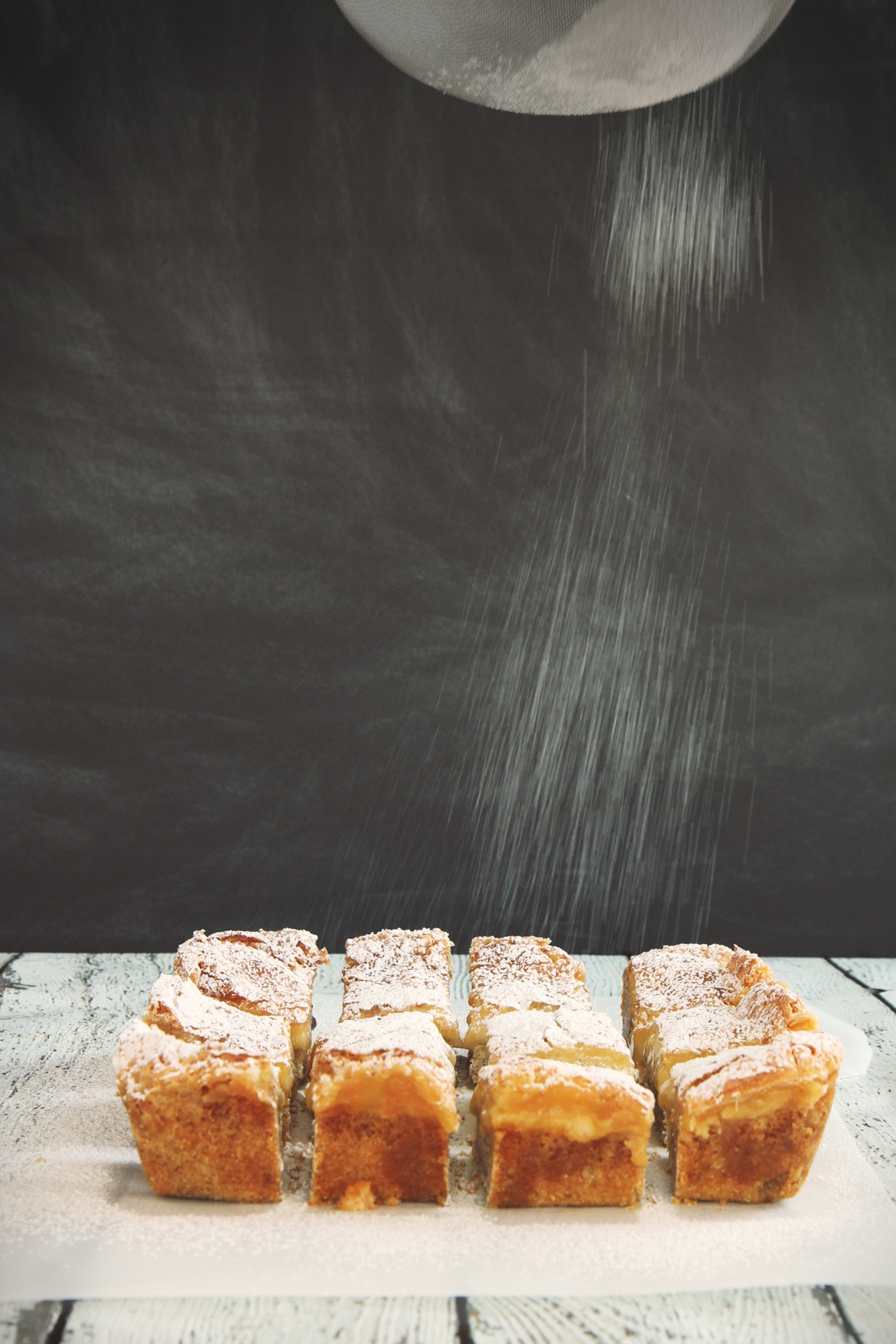
To serve, remove from freezer and immediately slice; dust with plenty of powdered sugar.

Dulcia

IMG_8270_01

“Carpamus dulcia, nostrum est
quod uiuis, cinis et manes et fabula fies.”

May we pluck sweet things, for after death we will be but ashes and a story.

-Persius 5.151-2

IMG_8246_01

Henceforth, I think it should be called drool-ce de leche.

I mean, really.

Soft, smooth caramel, rich with milk and always with an extra pinch of salt.
Could there be anything better?  Drizzle it on ice cream, put it into chocolates, sandwich it with cookies, fill cakes with it, stir it into coffee, eat it with a spoon… ahem.

IMG_8250_01

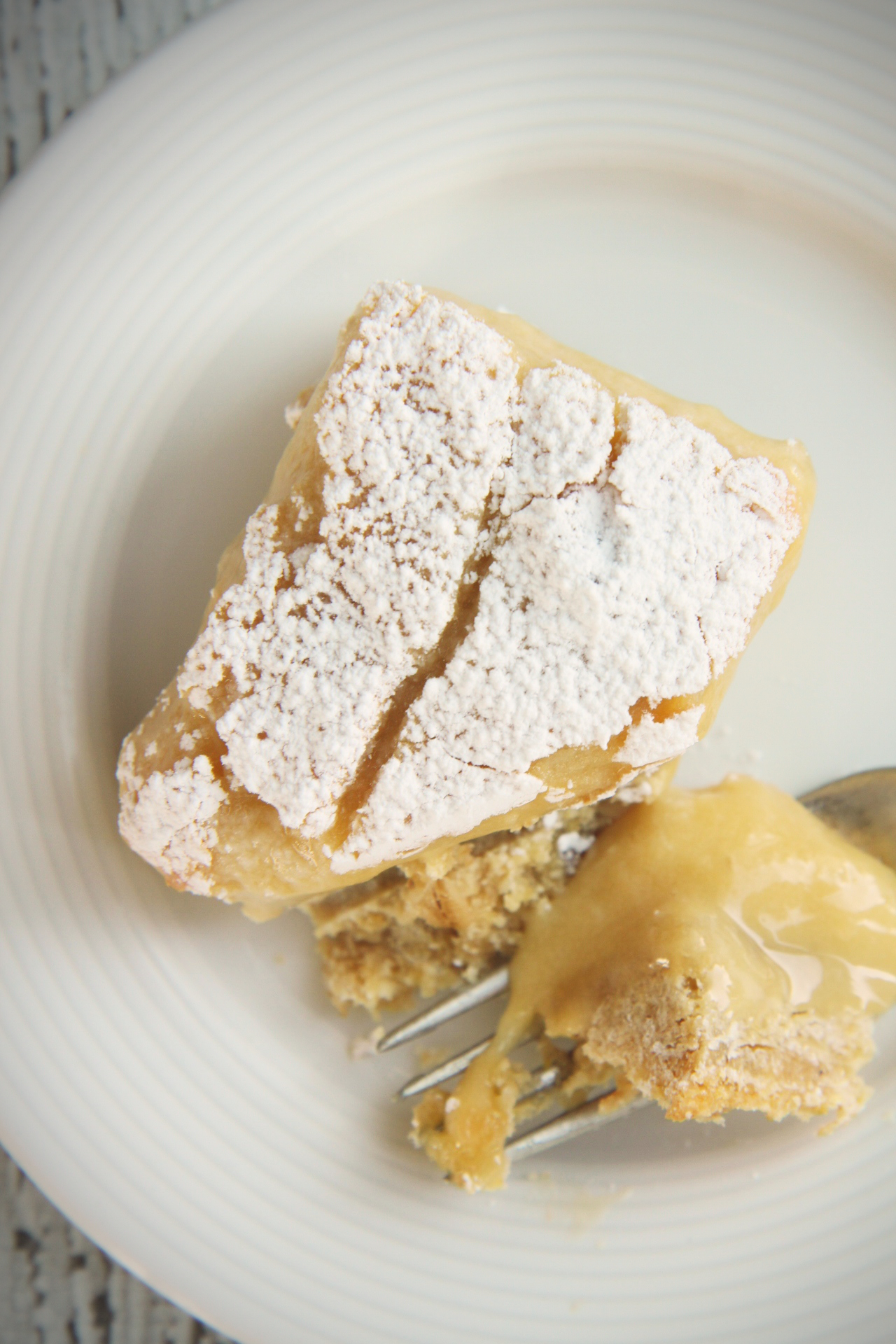
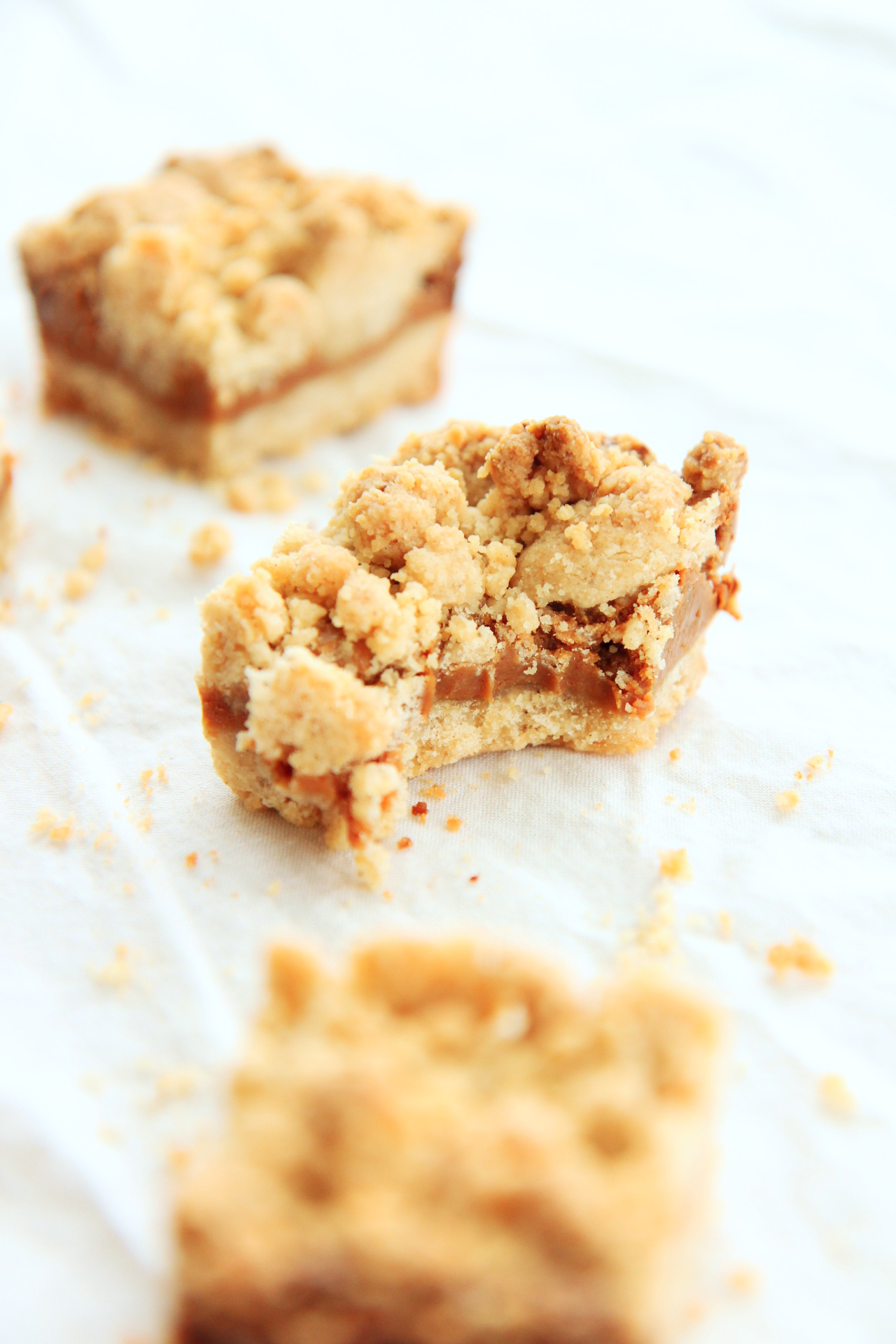
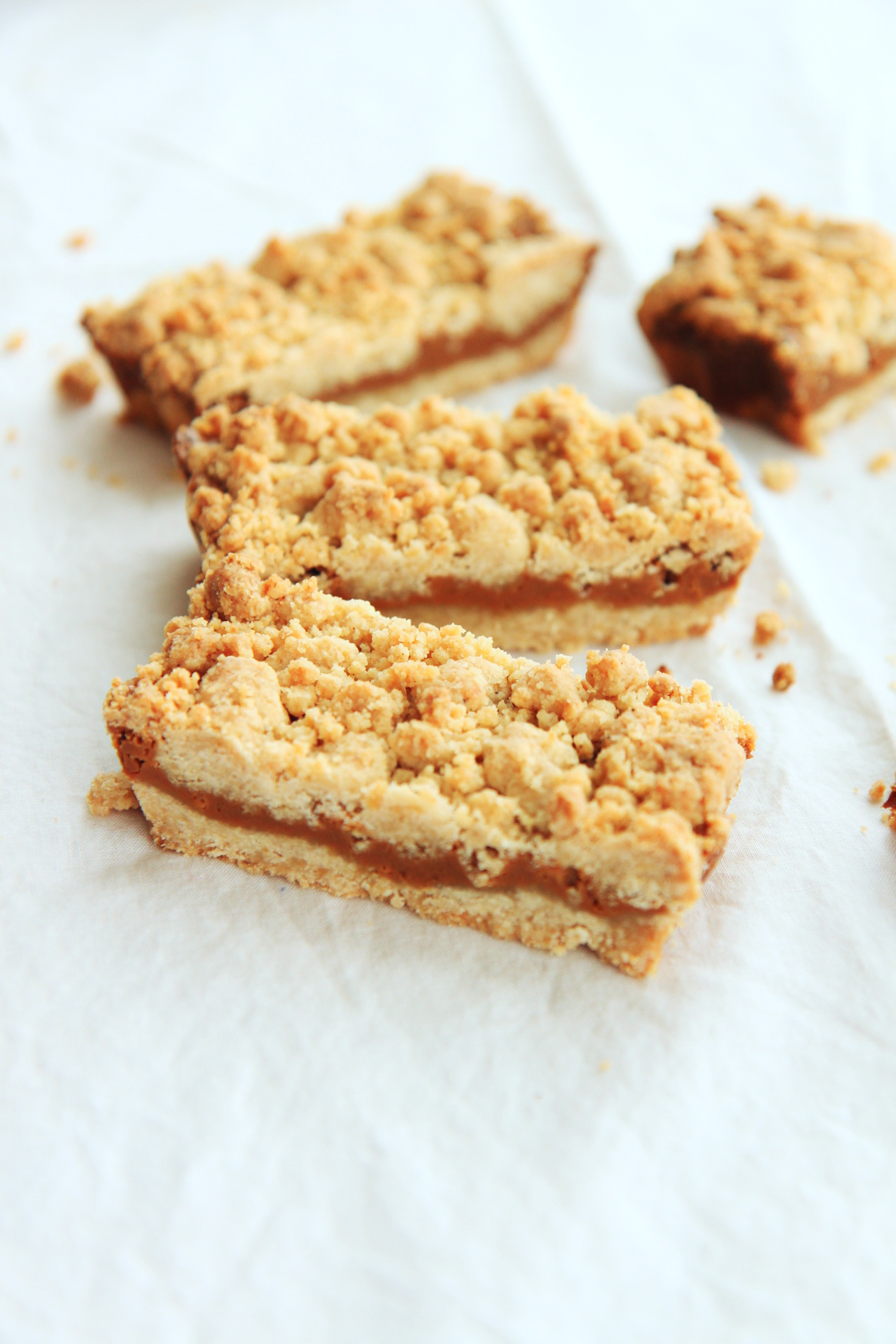
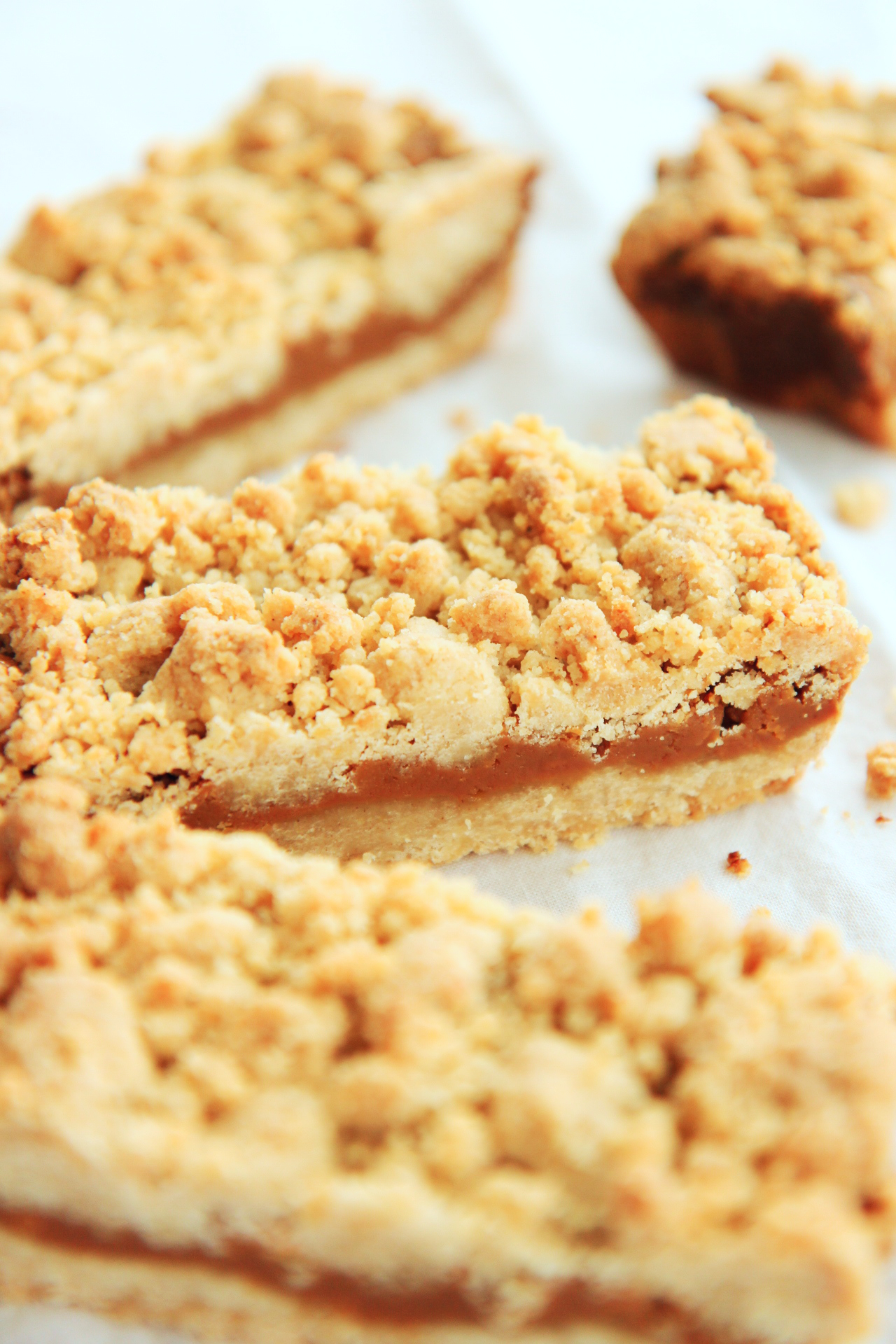
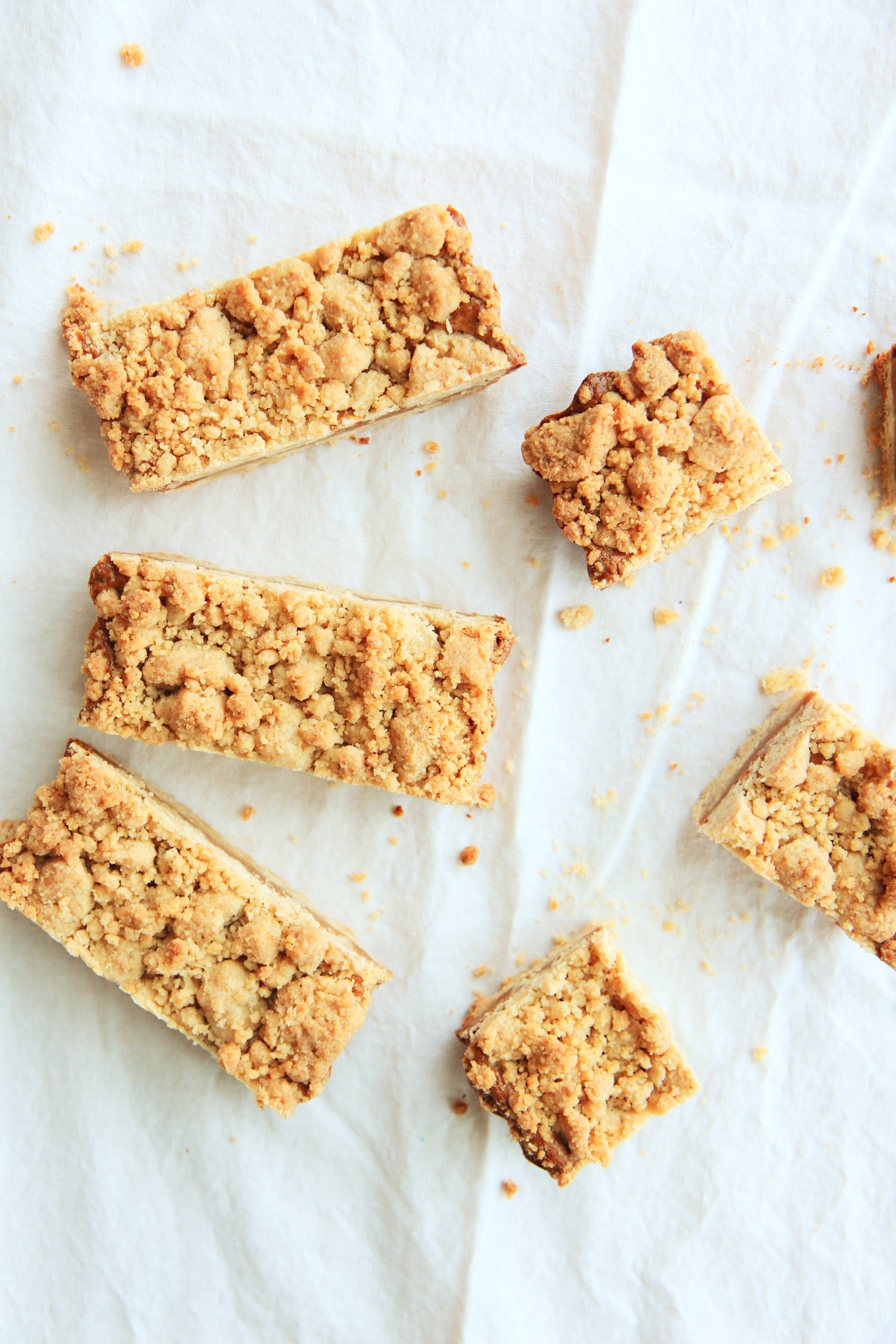
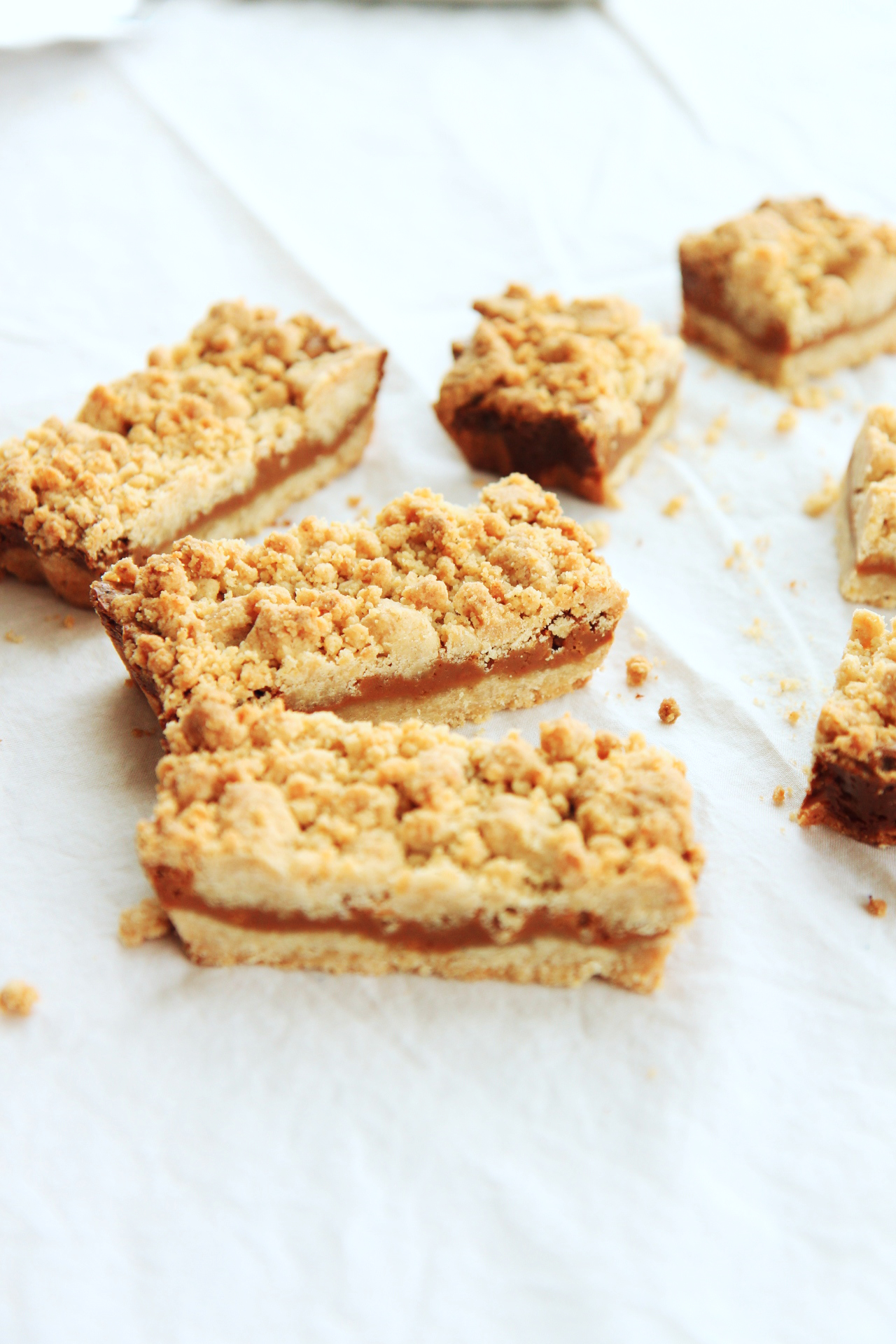
Other than eating it from a spoon, these cookie bars are the best use for dulce de leche I have encountered.

A thick layer of brown butter shortbread, redolent of vanilla is bathed in salty-sweet dulce de leche, then topped with more brown butter shortbread crumbs.

7 ingredients.  One bowl.  By far the best bar cookies on this blog.

My favorite parts were the caramelized, crunchy edges, which I maximized by making these bars in a rectangular tart pan.  Seriously addictive.  I love desserts with more than one texture.
Between the crunchy edges lie bites of super soft caramel sandwiched with crumbly shortbread.  Transcendent.

Best eaten with strong coffee or tea.  With friends.  It’s the only way to ensure you won’t eat the whole pan.

IMG_8251_01

The dulce de leche I used in these bars was my first attempt at making it on the stove top, with a shortened simmering time and no water bath.
I added about a 1/4 cup of brown sugar and a few hefty pinches of salt to a can of sweetened condensed milk, and cooked it in a heavy pan until it caramelized.  However, it hardened into (delicious) caramels, so I rewarmed it with 6 tablespoons of butter and another pinch of salt.  The dulce de leche didn’t want to absorb the butter, even when it was warm and pliable, so I added 2 tablespoons of skim milk and blended it with my immersion blender.

What resulted was the creamiest, smoothest dulce de leche I’ve ever tasted in my life.
It was thick and spreadable, like  La Salamandra (no joke) and was much richer than dulce de leche made with just sweetened condensed milk.  It also took a tiny fraction of the time (somewhere around 30 minutes, versus 2 hours in the oven).

Since it was the result of dumping a bunch of unmeasured things into a sauce pot, I can’t give you a solid recipe.
Yet.  It is in the works.  I promise.

But! These bars are way too important not to share.  Use some other recipe for dulce de leche, or even store-bought.(Do go for La Salamandra-type quality rather than Nestle, though…)

Here are some options:
the best way to make dulce de leche from a can (this is what I usually do)
completely homemade dulce de leche (omg.)
La Salamandra

See?  There are no excuses for not trying these cookies.

IMG_8247_01

Brown Butter Dulce de Leche Crumb Bars
makes 1 13 3/4x 4 1/2 inch tart pan; double for a 9×9 or 8×8 pan

ingredients:
1 cup dulce de leche
16 tablespoons (1 cup) butter
2 scant teaspoons kosher salt
1 cup sugar
1 egg
1 tablespoon vanilla extract
3 cups flour

directions:
Preheat oven to 350 degrees F.
Butter a 13 3/4 x 4 1/2 inch tart pan.
Place your butter in a heavy sauce pan and cook until browned and fragrant, about 5 minutes.
Scrape the brown bits and the butter into a large bowl; add the salt and sugar and whisk until fully combined, about 2 minutes.
Quickly whisk in the egg to prevent scrambling, then stir in the vanilla extract.
Dump the flour on top and stir with a large spoon until the dough comes together.
The dough will be cohesive, but you should be able to crumble very easily.
Press half of the dough into the bottom of your tart pan, firmly pressing to make an even layer.
Spread the dulce de leche all over the shortbread layer, then crumble the rest of the dough on top, pressing the crumbs slightly into the caramel to ensure that they will stick.
Bake for 25-30 minutes, until the crumbs are deep golden and the edges are caramelized.
Allow to cool, then slice and serve.

Maillard

IMG_7650_01

Some real fuckin’ foodie nerd shit is about to go down, y’all.

IMG_7641_01

This is the shit my chemistry T.A. and I talk about during lab discussion.
These cookies are bringing science back.
I am harnessing one of the most delicious reactions known to man and using its great and terrible power to make some kick-ass cookies.

And I’m SO excited to share these cookies and this technique with you.  Like, I can’t even.
I’ve been working on these here thangs for a while, now.
I’ve decided they’re ready to be unleashed upon the world.
The question is, are you ready?

IMG_7636_01

Do you know how freaking awesome the Maillard reaction is, man?
This is what is responsible for the heaven that is the crust of a good bread, the browning of butter, the golden color of baked cookies, cakes, and biscuits, dulce de leche, the crust of a steak, caramelized roasted vegetables, french fries, the smell of roasted coffee, chocolate, soy sauce, maple syrup

The Maillard reaction creates essentially all good smells in the kitchen.  It is an aroma powerhouse.
Roasting, toasting, baking, frying and their accompanying intoxicating smells are all derived from this reaction.

Can I get an amen?!

IMG_7668_01

The Maillard reaction describes the reaction between a single amino acid and a sugar.
It’s a form of nonenzymatic browning.
(The other main form of nonenzymatic browning is caramelization, which is the partial breakdown of a sugar.  The two reactions pair quite nicely, as both produce similarly delicious aromas, flavors, and colors.)
It’s favored in an alkaline environment, and requires heat to occur.
Because there are so many different combinations possible between amino acids and sugars, and because compounds can break down and form new combinations, the variety of aromas and flavors caused by the Maillard reaction is enormous.

Have you ever wondered why pretzels (les bretzels) are dipped in sodium bicarbonate (baking soda) solution before being baked?
It’s because the weak base of (CO3)2- creates an alkaline (basic) environment, facilitating and speeding up the formation of that lovely brown crust on the surface.
(I need to get a pretzel recipe on this blog, stat.)

Obviously, this interaction between amino acids and sugars has been happening since people started cooking and baking, but Louis-Camille Maillard first scientifically described the reaction in 1912, though he didn’t fully know the scope or details of it.
Oh damn! Hold up! That’s a French-ass name, Louis-Camille.  Yeah, my lil croissant, lil cheese on my croissant.

So as if we didn’t already know that the French dominate in the land of carbohydrates, they also pinned down the reaction that literally makes life and bread delicious.

Merci mille fois; mille fois merci.

IMG_7674_01

Blah blah science blah no one cares.
Except when it comes to cookies.
If science is guaranteeing better cookies, all y’all are gonna hop on board.  I know it.  I know you.

Brown butter is a go-to.  Any recipe that calls for melted butter is a boon, because I automatically brown my butter for a boost of nutty, rich flavor.
Butter browns because the proteins and sugar in the milk solids of butter toast and go through a certain reaction. (Hmm, what was that called again?)
What happens if you toast just milk solids, then?

Magic.

Put some milk powder in a dry skillet, stir it around, and wait.  It will slowly turn brown and toasty, and begin to let off enticing smells.  Don’t stick your face too deep to inhale, though, because you’ll get a nose full of milk.
Put this toasted milk powder into already browned butter, and you’ve just amplified the amount of Maillardian flavors all up in that butter.  By a lot.
Browning a stick of butter gets you about a tablespoon of browned milk solids.
These cookies add 3 tablespoons of browned milk solids to that.
Meaning you get cookies with the flavor of a pound of browned butter.
AKA flavor punch bang pow mother truckers.

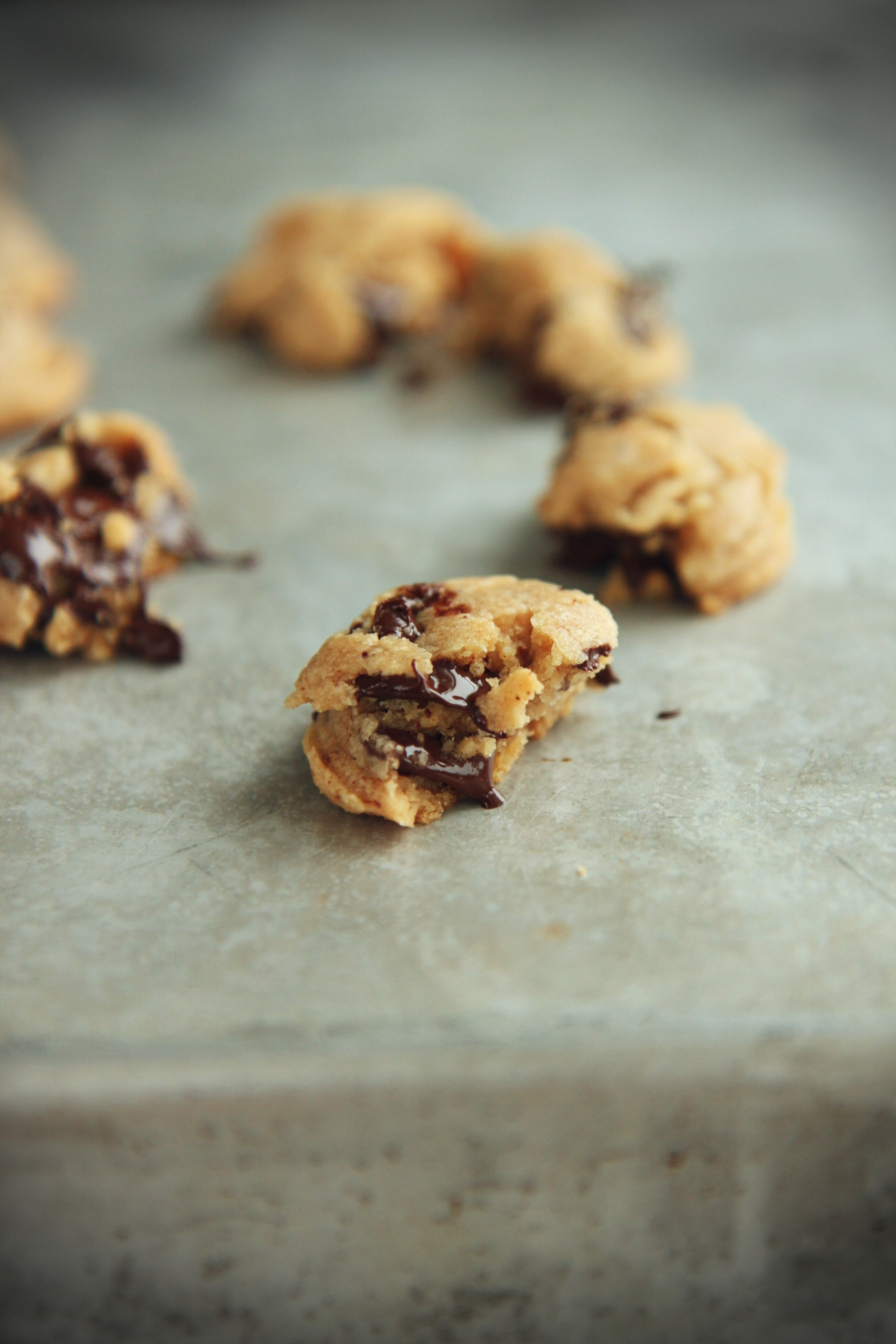
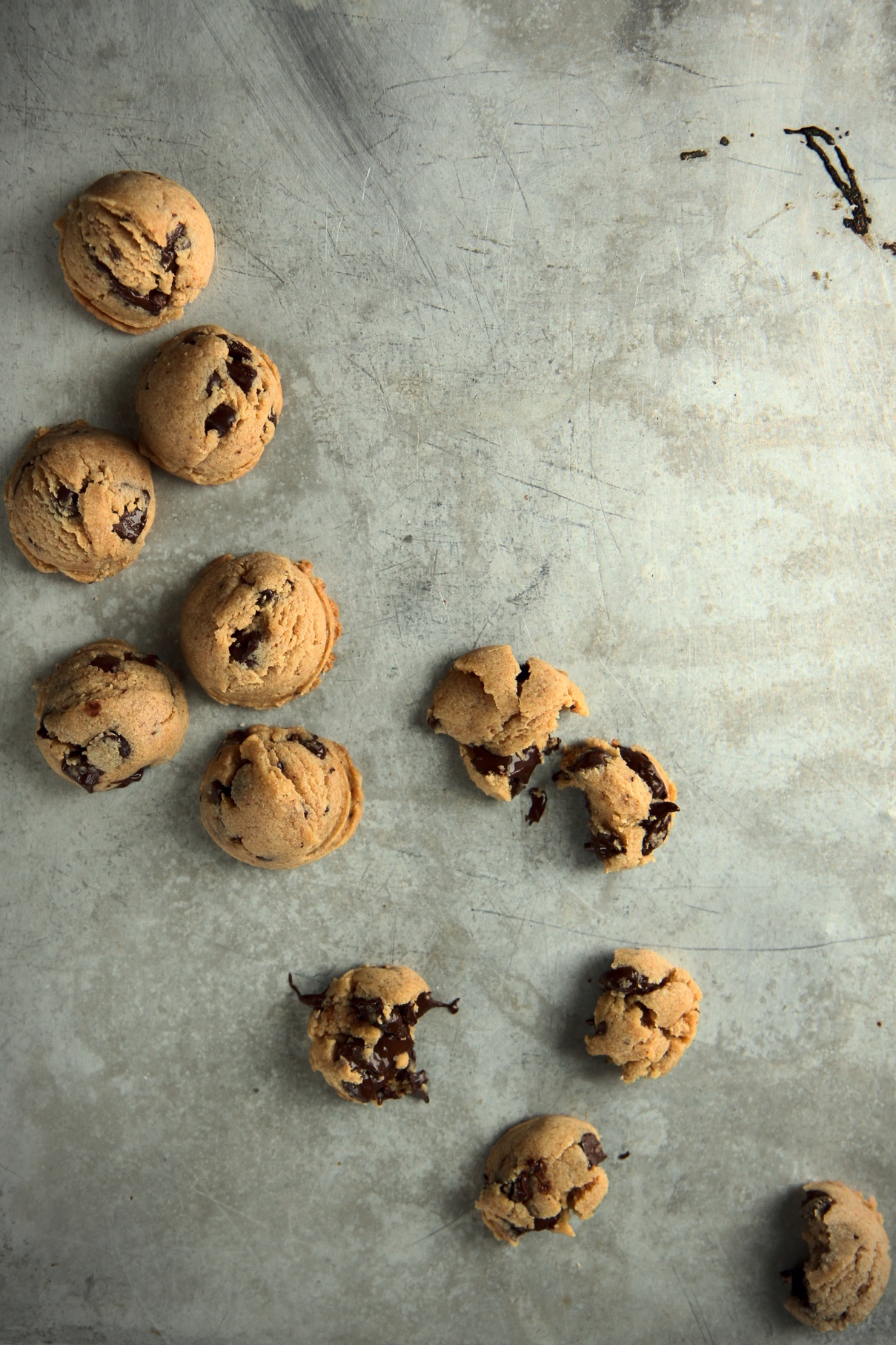
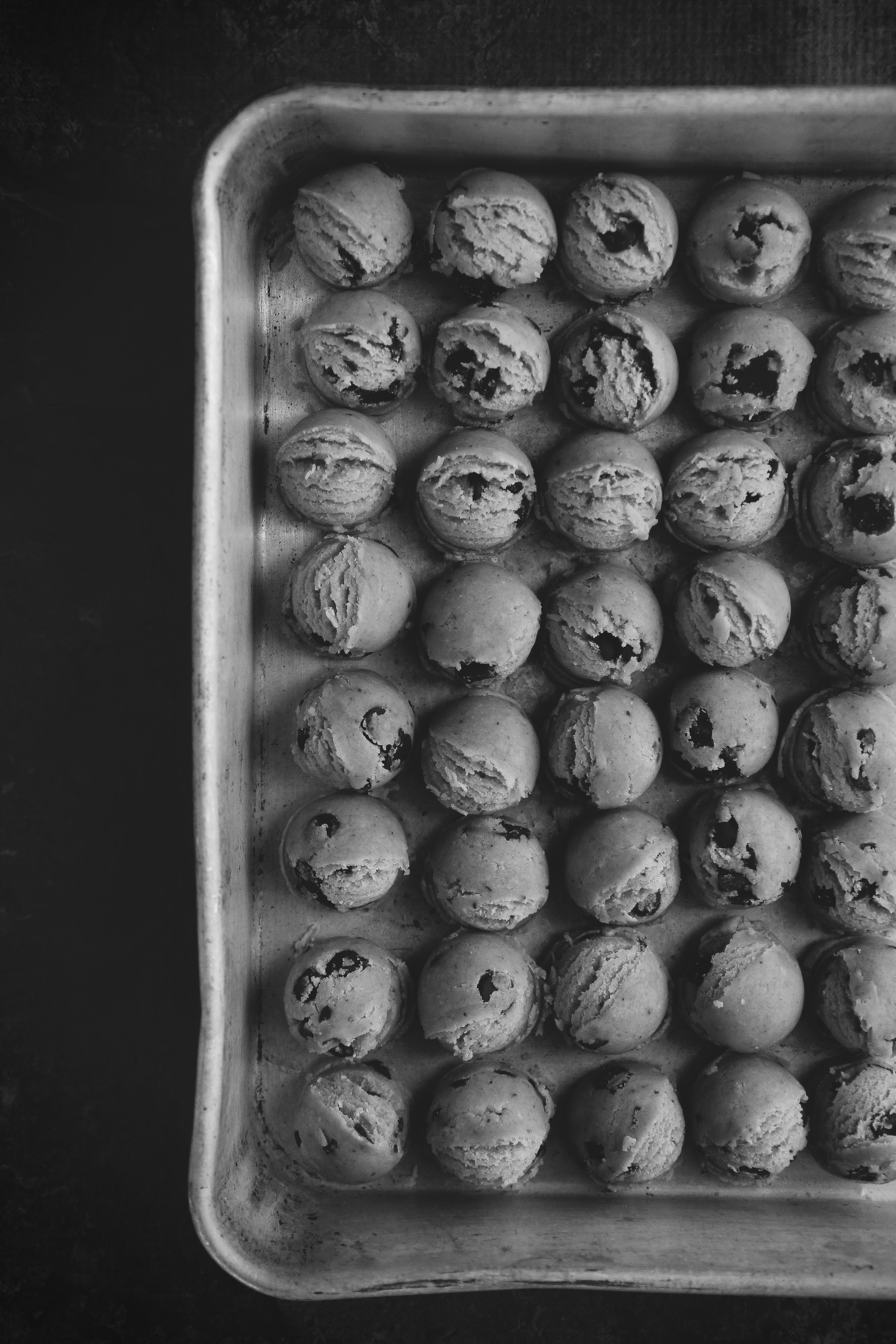
Super-charged brown butter, heaps of brown sugar, and a grand old dose of salt make up the base of these cookies, which will end up supremely soft and puffy, like little globes of deliciousness.
Stir in some chocolate chunks, portion out tiny little scoops, and prepare yourself for total cookie domination.
The alkaline batter (yep, we used sodium bicarb) goes into the oven, and even more Maillard reactions occur, both with the dough and with the chocolate.  Holy jeebus.  I’m drooling.

Eat them warm with a glass of cold, cold milk.
Cheers to Maillard.
Cheers to soft, salty, nutty, rich, profound cookies.
These ain’t no basic CCCs.
These are a chemist’s complex chocolate chip cookies.

It may be hard to mess chocolate chip cookies up, but it’s just as goddamn hard to make them freaking amazing.

IMG_7646_02

tl;dr
**make these cookies**

Some thoughts if you do try them, which you ought to: if you don’t want your cookies to be as puffy, I bet another tablespoon of milk plus a teaspoon and a half of neutral oil would do it.  I’ll get back to you on that.
Mini chocolate chips distribute more evenly in mini cookies.  I personally like big chunks, so I stuck with ’em.  Just keep that in mind.
For late night cravings, keep a batch of these in the freezer.  All you have to do from frozen is bake ’em for an extra minute, and that way, you’ll have cookies on hand for every sort of problem and situation that might arise.  Wrap well in plastic and aluminum foil to prevent freezer burn!
Sandwiching these with vanilla ice cream is all I want to do with my life.
They would also make a perfect mix-in for ice cream, because they are so so soft.

Number one tip: consume while fresh and hot hot hot.

Shoutout to science and shit, baby.  Bang bang.

P.S. Did you notice the blog’s facelift?
I spent wayyyyy too long designing the new logo and updating fonts, etc.
Tell me what you think!

IMG_7632_02

Maillard Chocolate Chip Cookies
makes about 50 tiny cookies, or 12 large

ingredients:
3 tablespoons milk powder
3/4 cup unsalted butter, browned and then cooled until hardened
3/4 cup packed brown sugar
1/4 cup sugar
3/4 teaspoon kosher salt
1 egg
1 teaspoon vanilla extract
1 tablespoon milk
2 cups all purpose flour
2 teaspoons cornstarch
1 teaspoon baking soda
1 cup bittersweet chocolate chips or chunks

directions:
Brown the butter well ahead of time and set it in the fridge to cool back to a solid state.
Brown the milk powder: in a NONSTICK skillet over low heat, stir the milk powder gently until a deep tan color and very fragrant, about 10-15 minutes.
Be sure not to let it burn.
Scrape the solidified browned butter along with the browned milk powder into the bowl of a stand mixer fitted with the paddle attachment and beat until soft, about 2 minutes.
Add the sugars and the salt and beat for 2 more minutes.
Add the egg and vanilla and beat until very light and fluffy, 5 more minutes (stop to scrape the bowl after 3 minutes).
Add in the milk and beat for 30 seconds, just until incorporated.
Add the flour, cornstarch, and baking soda to the bowl with the mixer off.
Slowly stir in the flour, with the mixer or by hand.
Once the dough is completely homogeneous, add in the chocolate chips and stir to combine.
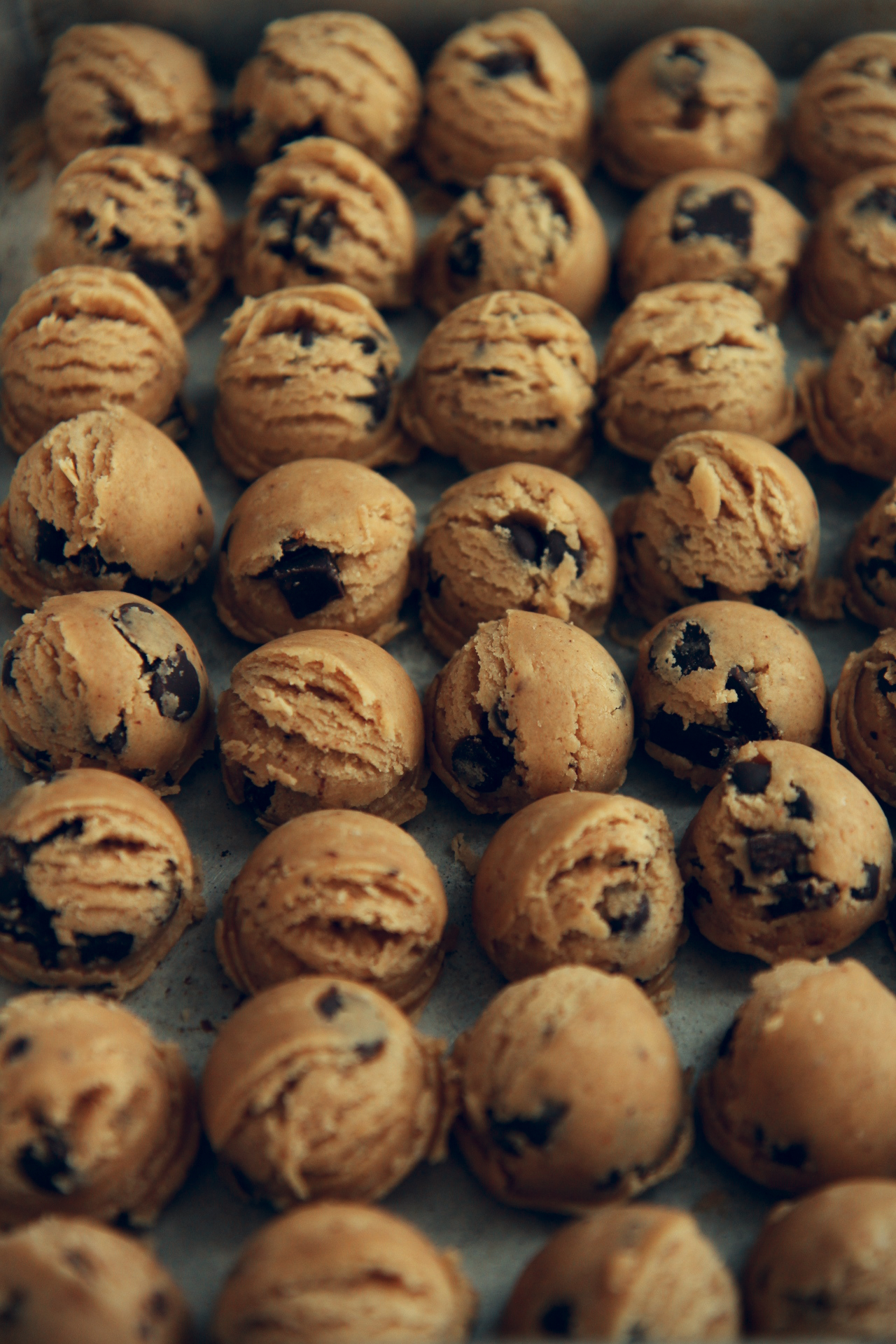
Portion out in 2 teaspoon (smallest cookie scoop) measures for tiny cookies, or in 1/3 cup (standard ice cream/cookie scoop) portions for standard size cookies. (The larger portion size will yield approximately 12 cookies.)
You can now chill the dough balls overnight, or freeze, well wrapped, for much longer.
Bake at 350 degrees F for 6 minutes for tiny cookies, 8 minutes for larger cookies.
Cookies will seem very doughy and underdone; as they cool, they will remain super soft.
Eat warmed up with cold milk.

As Promised

IMG_7170_01

This post is a wee bit out-of-season.  You might not be able to find candy canes at the grocery store.
Check the clearance section.  If you still can’t find any, you’re S.O.L.

Just kidding.  I advocate the use of sprinkles, as you probably already know.

I’ve made lofthouse-style cookies once before, and dumped on the brand in a whiny post a lo o o o o ong time ago.

I am not providing a link to said post, and don’t you go nosing around for it either, primarily because the photos look like they were taken with a flip phone from 2007 (Razr, anyone?  I had the Pebl.  Gr8.) and I don’t want to be reminded of that.

Ok?  Ok.  Glad we talked about this.

These lofthouse cookies are the (late) peppermint post that I promised would infuriate you.

Be happy, because I came thisclose to not only posting a candy cane post after the holidays, but making it a repeat recipe from the-post-that-shall-not-be-named-searched.

THISCLOSE.  But.  I found another promising recipe, and ran with it.

This one uses cake flour and corn starch, as well as shortening (Don’t look at me like that. I know. Deal with it.) to keep the cookies super soft and fluffy, where the last recipe used sour cream.
These were more cakey than real lofthouse cookies, but nevertheless, delicious, and pretty damn close to the addictively gross originals.

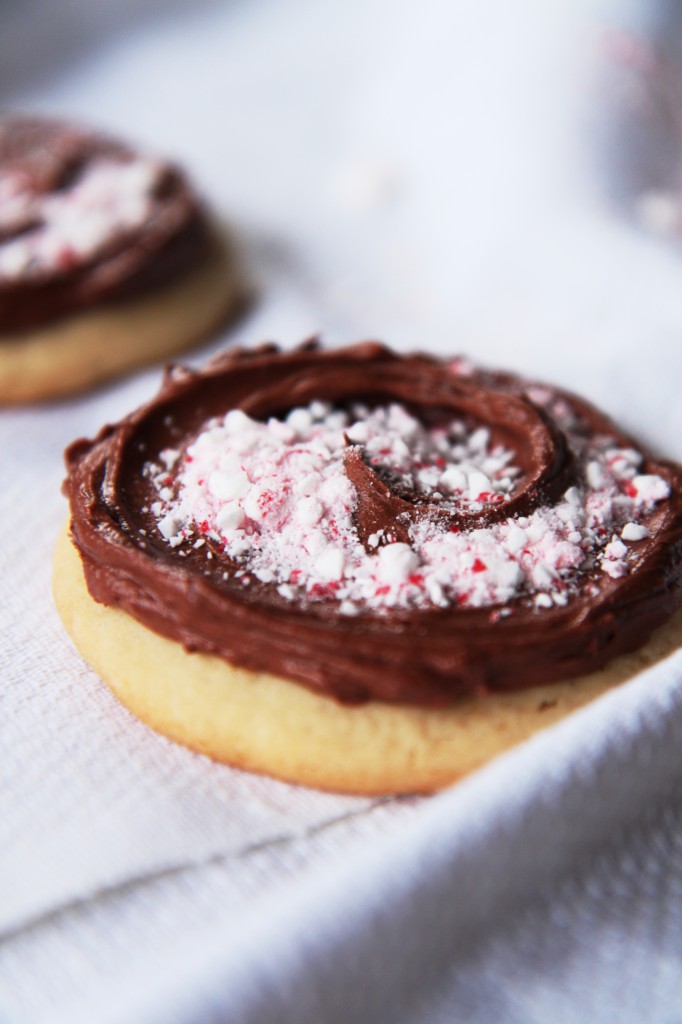
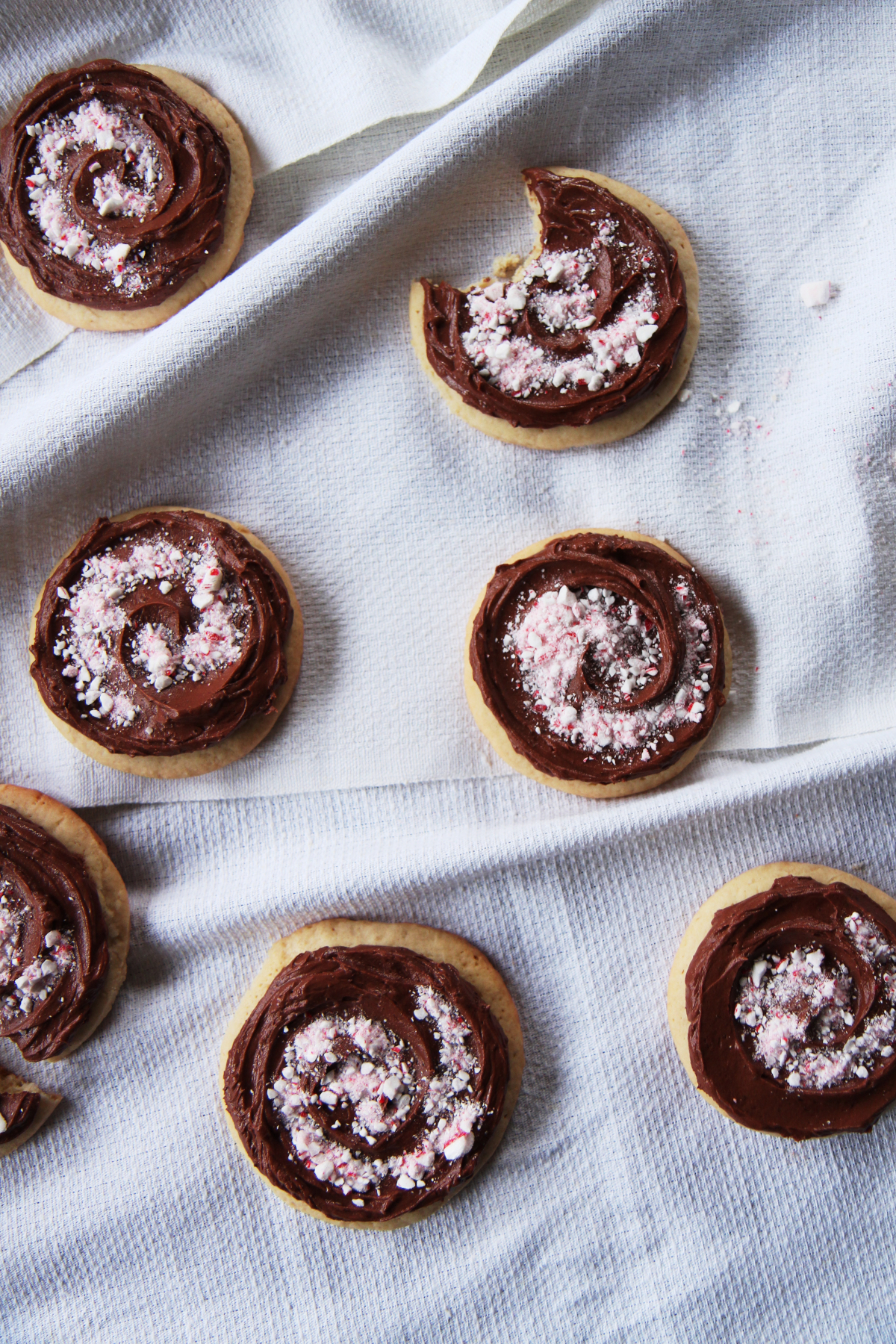
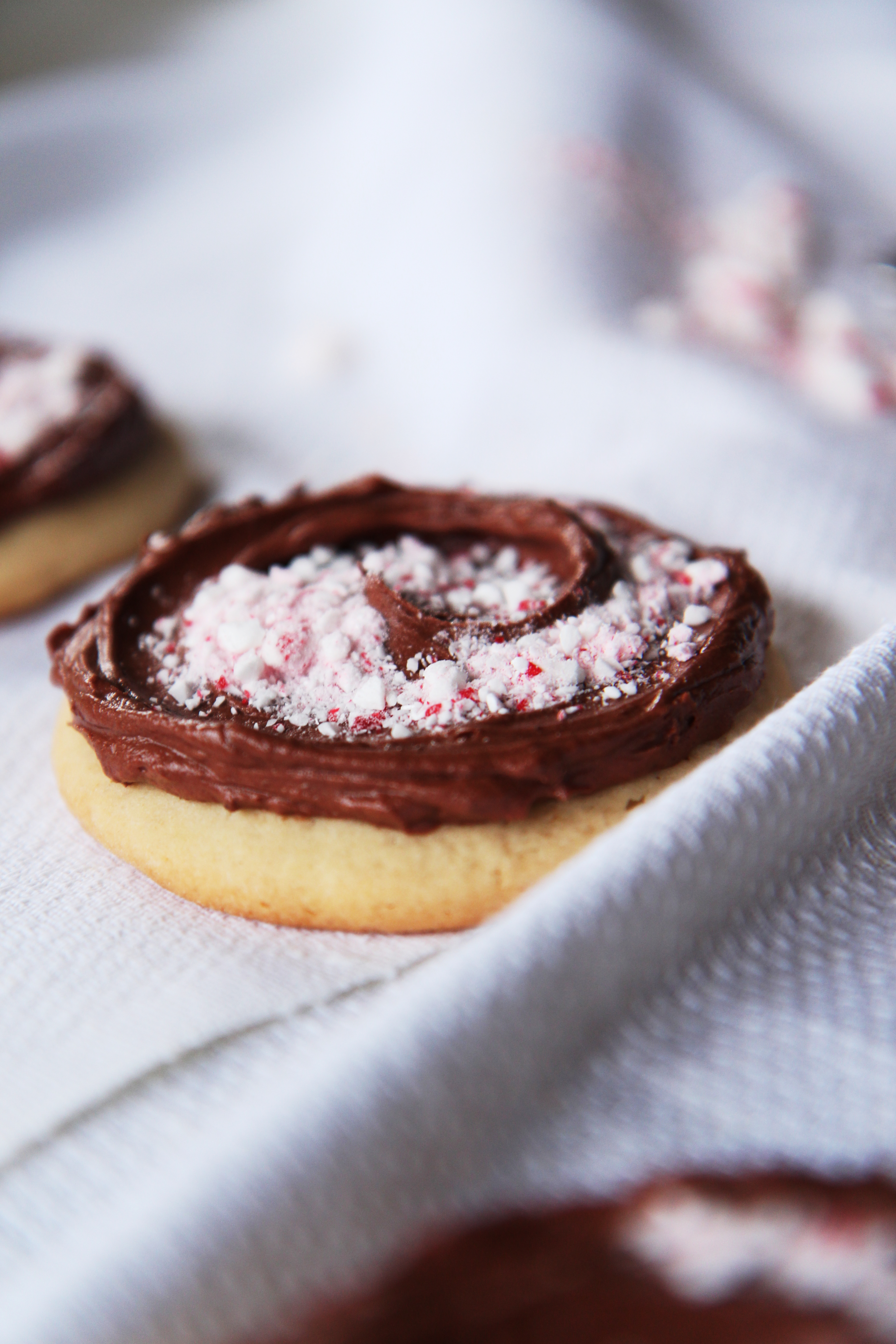
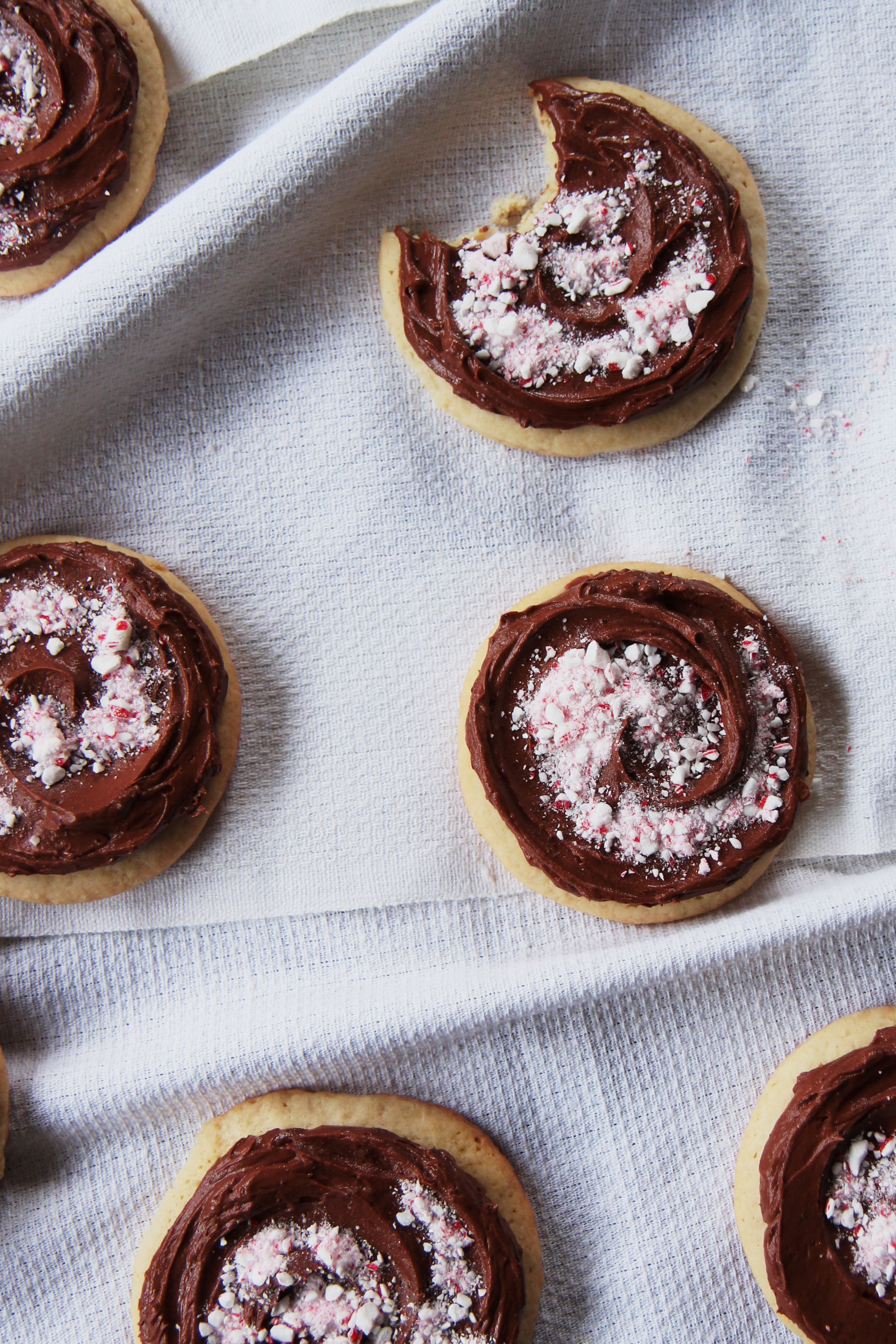
I topped them with a salty espresso + chocolate buttercream and a smattering of crushed candy canes for crunch. (Hellooooo alliteration nicetomeetyou.)

IMG_7180_01

P.S. I realize that these photos are very similar looking.  No, this isn’t one of those spot-the-difference games.

I’m just lazy, which should further confirm your idea of me as a bad blogger.

Anyways!  Good luck finding candy canes.  Ha.

IMG_7222_01_01

Chocolate and Peppermint Lofthouse Cookies
makes about 15 cookies
cookie portion adapted from Cooking Classy
ingredients:
for the cookies:
300 grams (2 1/2 cups) cake flour
2 teaspoons cornstarch
1 1/2 teaspoons baking powder
110 grams (1/2 cup, 8 tablespoons) butter
55 grams (1/4 cup, 4 tablespoons) vegetable shortening
200 grams (1 cup) granulated sugar
scant 1/2 teaspoon kosher salt
1 egg plus 1 egg white
1 tablespoon vanilla extract

for the frosting:
60 grams (~2 ounces) dark chocolate, melted
110 grams (1/2 cup, 8 tablespoons) butter
1 tablespoon cocoa powder
2 teaspoons espresso powder
45 grams (1 1/2 cups) powdered sugar
1/2 teaspoon kosher salt

to assemble:
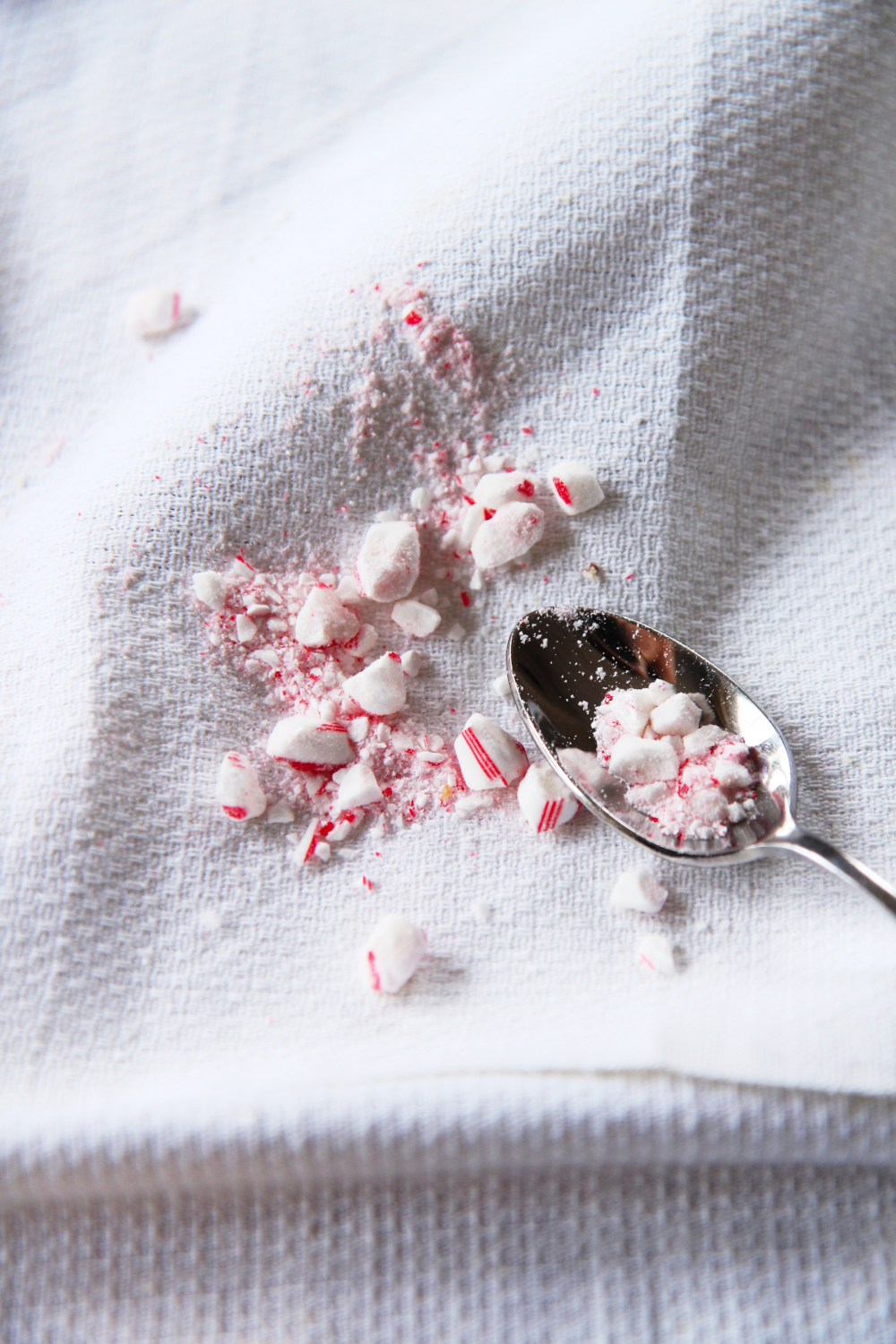
2 candy canes, chopped finely or ground in a food processor

directions:
In the bowl of a stand mixer, add the butter and shortening and beat for 2 minutes.
Add in the sugar and salt and beat for 3 minutes.
Add the egg and egg white as well as the vanilla and beat for 4 full minutes.
Meanwhile, whisk the flour, cornstarch, and baking powder together.
Scrape the sides of the bowl after 4 minutes of beating, then add in the flour mixture and mix on low speed until combined.
Refrigerate the dough for at least 1 hour.
Preheat oven to 350 degrees F.
To bake, remove the dough from the fridge and roll out to 1/2 inch thickness, or perhaps a little less, on a well-floured surface.
Cut out desired shapes and place on parchment lined baking sheets.
Bake for 8-10 minutes, until set.
To make the frosting, beat the butter and espresso powder on high until very soft.
Sift the powdered sugar and cocoa powder over the butter and mix on low; mixture will be dry.
Add the salt and, with the mixer running on medium speed, stream the melted but cooled chocolate into the frosting.
Beat until completely homogeneous.
To frost the cookies, place a generous tablespoon of frosting onto the cookie, and spread out with a butterknife or offset spatula.
Dust with candy cane pieces.

To the Core

IMG_7485_01

“Our biggest disagreement was about chunks.
Ben came up with the flavors and I did the manufacturing, and he wanted bigger chunks and I wanted small ones with greater distribution.
He said people didn’t care if you got a chunk in every bite as long as you knew that fairly soon you’d get a chunk.”

Jerry Greenfield

IMG_7489_01

I think we can apply Ben Cohen’s theory about ice cream chunks to life happiness.

How important, and too often forgotten, is the idea that not every bite will or needs to contain a chunk?
We’re so trained for instant gratification that anything less feels like deprivation.
We forget that not every day needs to be perfect or leave you fulfilled.
You don’t need to be cheery and happy every minute to feel satisfied in the big picture.

We think about our lives in terms of monumental moments; we measure the passing of time with the passing of tragedies and victories.
What about all the days where nothing “of importance” happens?

IMG_7491_01

They are to our lives as bites without chunks are to Ben and Jerry’s, as junk DNA is to genes.
From the outset, they seem less important.  Undesirable, useless.  Wasted.
But more flies under our radar, which is tuned to big spikes in emotion, than we think.
Little things.  Daily things, both annoying and delightful.

The first bite of a crisp apple.
Losing your keys, phone, wallet, mind.
A smile from a passerby.
Stubbing a toe.  Twice.
The smell of cookies baking.
Being overworked and overtired at the end of a long day, a long week, a long year.
Snuggling into your own bed.

So much that we take for granted is beautiful in its own right.

I intend to practice more gratitude and appreciation for the plain, the mediocre, the underappreciated, the kind-of-crappy happenings in my life.
I intend to take each moment as it comes, to breathe it in and live in it,
to meet it with a smile and know it fully.

Each moment of each day in our fantastic, terrible world deserves meaning.

IMG_7505_01

It is a sophisticated hope, then, that sustains true, lasting happiness.
The hope—or rather, the knowledge—that you’ll get a “chunk” fairly soon.
And the deep and conscious enjoyment and appreciation of every moment, every plain bite of ice cream, every pretzel in the Chex mix.

Food for thought.  Thought for food.

IMG_7494_01

Speaking of food… Cupcakes?!  Again?!  Who am I?!
Just last week, I made these “teatime” cupcakes.  And I loved them!
Photographing cupcakes is more pleasant than cookies, and lord knows I’ve made enough of those in recent times.
So.  Many.  Cookies.
Thus, despite my semi-loathing of cupcakes, I made more.

Part of my newly affirmed affection for cupcakes is that I’ve been frosting them with a meringue buttercream.
Seriously, I used to think that thick, American-style buttercream was a decent choice for cupcakes.
But, truthfully, there is no comparison to a cloud of rich, glossy IMBC.
Especially not a brick of confectioner’s sugar/butter ABC.

I wax on about meringue buttercreams all the time (not sorry) but that’s because they’re amazing.
Light, easy to pipe, smooth, shiny, stable, flavorful.
(I’m an adjective junkie.)

They’re only minimally more work, are less likely to break/curdle/be gross and are therefore totally worth the extra 10 minutes of prep.
Give your favorite cupcakes a makeover with some IMBC and you won’t recognize them, or ever even look back.

Maybe you don’t like cupcakes, like me.
I swear to you, cupcakes frosted with IMBC may change you.

IMG_7502_02

These cupcakes were inspired by Ben and Jerry’s ice cream!

One of their “core” UK flavors is called Peanut Butter Me Up.
It’s half peanut butter and half vanilla ice cream, surrounding a core of raspberry jammy goodness.  The vanilla is studded with peanut butter cups.
Sounds like a perfect pint to me.  Heaven is peanut butter+vanilla+fruit.
Why don’t we have it in America?  I don’t know.  But it’s killing me.

These “Peanut Butter Me Up” cupcakes are a soft, buttery, salty PB cake, filled with tart raspberry jam, topped with a big fluff pile of vanilla Italian meringue buttercream, topped with a peanut butter cup.

I used raspberry preserves made only with pomegranate juice as the sweetener, so it was extra tart and tangy!
I only made 12 cupcakes, but there was definitely enough batter/buttercream to make 16 or 18 cupcakes, so I’ve adjusted the yield in the recipe to reflect that.

Since I can’t get the ice cream here, I’ll have to stick with cupcakes.
Somehow, I’m OK with that.

IMG_7508_01

Peanut Butter Me Up Cupcakes
makes 16-18 cupcakes
cake portion adapted from Serious Eats

ingredients:
for the peanut butter cake:
4 tablespoons butter
1 packed cup brown sugar
3/4 teaspoon kosher salt
3/4 cup creamy peanut butter
2 eggs
3/4 cup milk
2 teaspoons vanilla extract
1 1/2 cups flour
1 1/2 teaspoons baking powder

for the vanilla Italian meringue buttercream:
3 egg whites
1 cup sugar
1/4 cup water
big pinch salt
6 ounces (3 sticks) butter, cut into small bits, soft but cool
1 teaspoon vanilla extract

to assemble:
raspberry jam, approximately 1/2 cup
mini peanut butter cups

directions:
Make the cupcakes: preheat oven to 350 degrees F.
Line 18 muffin tins with papers.
Beat butter until softened, about 1 minute.
Stream in brown sugar and salt and beat for 3 full minutes.
Add in the peanut butter and beat for 3 more minutes.
Add in the eggs, one at a time, and beat for 2 full minutes.
Mix the milk and vanilla extract, and, very slowly and carefully, stream into the batter while slowly, slowly mixing to prevent splashing.
Dump the flour on top of the batter and add the baking powder over the flour mound.
Slowly stir batter until homogeneous (it will be thick).
Portion out with an ice cream scoop into your tins.
Bake for 22-26 minutes, until springy to the touch, very fragrant, and a tester comes out with only a couple crumbs.
Allow to cool completely.

Make the vanilla Italian meringue buttercream: combine sugar, salt, and water in a heavy bottomed pot.
Place egg whites in the bowl of a stand mixer.
Begin to whip egg whites on medium speed while heating the sugar syrup over medium-high heat.
When the sugar syrup reaches 230 degrees F, your egg whites should be at very soft peaks.
By the time the syrup reaches temp at 245 degrees F, your egg whites should be at soft peaks.
Slowly and carefully pour the hot syrup into the whipping egg whites.
Whip the meringue until it reaches body temperature, then begin to whip in the butter, 1 tablespoon at a time.
Add the vanilla and continue to whip the buttercream at high speed until it becomes fluffy, glossy, and thick.

Assemble the cupcakes: place your raspberry jam in a piping bag fitted with a plain tip.
Plunge the tip into the cupcake and wiggle it around, applying gentle, even pressure to fill the cake, until the pressure forces the tip out of the cake.
Frost the cupcakes with the meringue buttercream as desired, then top with a peanut butter cup!

Dreamy

IMG_6815

In my dreams, I can fly eat cake whenever I so desire.

IMG_6822

Welcome back, friends.  I’ve missed this little place for the last few days, but I’ve been off being very busy sleeping and reading and relaxing.  Ahhhh.

I hope you all had a couple marvelous days off from all your duties, whether they were for celebrating xmas or not!

I have so enjoyed being with my family.  It is a magical time of year, when we can all get together and all keep our heads calm.
Here’s to family!
And here’s a gif for my oldest brother who calls them “GIHFs,” even though it is clearly “JIFs.”
He is a lost cause.

j

These cakes, however, are not lost.  My mouth found them altogether too quickly.

These are the stuff of dreams!  Little coconut jewels, small and personal.  Like cupcakes, but better.

They’re simple, and not too sweet.
Buttery, and yet inconceivably fluffy.
Richly flavorful, but incredibly simple.

In fact, there are only two easy easy easy components to these little cakes!
Buttery coconut cake
 is baked in a sheet pan, then cut out and layered with coconut Chantilly cream.
Heavenly!

IMG_6795

A note on equipment, as these cakes require a couple finicky little pieces, i.e. a small jelly roll pan and some cake rings.

I used this sheet pan. (Cheap, semi-durable.)
I used molds similar to these cake rings. (Super durable.)

This is what I used to eat them.

May your dreams be full of cake!

P.S. For the loveliest of dreams, listen to this combination.  Makes me cry.  And smile.

IMG_6817 

Coconut Stack Cakes

makes 3 2-inch cakes (from a 10×15 inch sheet pan)
ingredients:
for the cake:
77 grams butter
167 grams sugar
40 grams brown sugar
2 eggs
63 grams full-fat coconut milk
10 grams lemon juice
50 grams grapeseed oil
8 grams vanilla extract
123 grams flour
2/3 teaspoon baking powder
big pinch kosher salt

for the whipped cream:
240 mL heavy cream
15 mL full-fat coconut milk
7 grams powdered sugar

directions:
Preheat oven to 350 degrees F and grease and flour a 10×15 inch jelly roll pan.
Beat butter for 2 minutes to soften.
Add the sugars and beat for 4 more minutes.
Scrape the bowl and beat in the eggs for 2 more minutes.
Scrape the bowl and add the coconut milk, lemon juice, oil, and vanilla extract; beat until homogeneous.
Add the flour, baking powder, and salt and mix on low until combined.
Scrape the batter into the jelly roll pan and spread out evenly.
Bake for 18-22 minutes, until golden and firm to the touch.
Allow to cool completely, then cut circles out with 3 inch cake rings.
You should get 12.
Whip cream to soft peaks, then gently beat in coconut milk and powdered sugar.
Place one cake circle in the bottom of a cake ring.
Spread 2 tablespoons of whipped cream onto the cake base.
Place another cake circle on top of the whipped cream and repeat so that each stack cake gets 4 layers.
Press down gently to release the cake, then top with pearl sugar, coconut flakes, and kumquats.